Tag Archives: AI in Private Equity

Private equity firms are now operating in an environment where size, speed, and compliance are essential for success. As private equity funds continue to grow and their investors continue to come from all over the world, operational issues have become much more challenging. The reporting cycles continue to become shorter, the need for transparency in data continues to increase, and the need for compliance continues to grow. In this environment, private equity fund administration outsourcing has moved from a cost-saving exercise to a way of doing business. The latest reports from PwC and Deloitte indicate that fund managers currently devote a substantial amount of their internal resources to non-investment activities such as accounting, investor reporting, and regulatory filings. By outsourcing these functions, managers can devote more time to deal sourcing, enhancing the value of their portfolio, and developing relationships with investors. Most importantly, outsourcing brings in high-quality processes and technology that would otherwise require substantial investment.
As limited partners expect accuracy, speed, and transparency, outsourcing provides a practical solution to meet these needs without losing focus.

Private Equity Fund Administration Outsourcing and the Evolving Operating Model

This trend toward outsourcing is evident in the rapid growth of the fund administration outsourcing market. The global market size reached USD 12.4 billion in 2024 and is expected to grow at a rate of 8.1% annually until 2033, potentially hitting USD 24.2 billion. North America remains the largest market, around USD 5.1 billion, thanks to an established private equity environment and increased regulatory scrutiny. Europe follows with USD 3.6 billion, helped by cross-border fund setups and frameworks like AIFMD. The Asia/Pacific area is the fastest-growing market, reflecting an increase in alternative investments and cross-border capital flows. Private equity fund administration outsourcing is indicative of a broader trend in the way fund managers organize their businesses. Rather than maintaining large in-house staffs, firms are increasingly turning to partners to manage necessary administrative functions while their staffs concentrate on higher-level work. Recently, the global private equity industry surpassed several trillion dollars in assets under management, according to MSCI and Preqin. As this has expanded, the amount of capital calls, distributions, valuations, and investor communications has grown dramatically. Many general partners find that traditional in-house teams are struggling to keep up.

Private Equity Fund Administration Outsourcing and the Evolving Operating Model

Private Equity Fund Administration Outsourcing and the Evolving Operating Model

Rising Complexity in Fund Structures

Modern funds employ multi-tier structures, co-investment funds, and parallel funds in various regions. Each of these fund structures has its own set of accounting requirements. Private equity fund administration outsourcing assists in making these processes more standardized by employing experienced personnel to handle similar structures. This increases the efficiency of operations and makes them more audit ready.

Investor Expectations and Transparency

Limited partners require almost real-time reporting on the performance of funds. Quarterly reporting is no longer adequate. According to Deloitte’s 2024 alternative investment survey, institutional investors consider transparency and data quality to be among their top evaluation points. The outsourced administrators are likely to provide secure portals and reporting formats that address these requirements effectively.

Cost Flexibility and Scalability

Establishing an in-house administration team involves fixed costs of employment and training. Outsourcing involves a shift from fixed to variable costs that scale with the size of the funds. This flexibility is especially important for new managers and mid-market firms seeking high-quality operations without the substantial overhead. Many firms already apply this approach when engaging external partners for private equity-related operational support, forming a consistent outsourcing-driven ecosystem.

Private Equity Fund Administration Outsourcing and Regulatory Compliance Pressure

The pressure of regulations has increased in the global private equity market. The government has now begun demanding complete disclosure, strict deadlines, and accurate record-keeping. Private equity fund administration outsourcing is a major area that helps companies overcome such problems with confidence. In the last few years, there has been an increase in reporting obligations from regulators in North America and Europe regarding investor protection, valuation, and fees. According to PwC, failure to comply with these regulations can result in financial consequences, such as penalties, and damage to reputation, which affects future fundraising activities.

Standardized Reporting and Controls

Outsourced administrators work according to internal controls, procedures, and compliance checklists. These frameworks help ensure that financial statements, capital account reports, and regulatory filings follow consistent standards. Maintaining this level of rigor internally often requires considerable investment.

Audit Readiness and Data Integrity

The audit process is one of the most resource-intensive steps for fund operations teams. Outsourcing makes this process easier by maintaining clean and well-documented records throughout the year. Experienced administrators who know how to work with global audit firms reduce friction and cycle times for audits. This reliability also supports subsequent activities like capital raising, where historical accuracy builds investor trust.

Cross-Border Regulatory Knowledge

As funds expand globally, compliance requirements differ by jurisdiction. Outsourced providers have regional expertise and keep track of regulatory updates across markets. This reduces the burden on internal teams and lowers the risk of non-compliance. Similar benefits can be seen when firms outsource other complex functions, such as managing multi-jurisdictional fund structures.

Private Equity Fund Administration Outsourcing and Technology Enablement

Technology has become essential for effective fund administration. Private equity fund administration outsourcing usually provides access to systems that individual firms may find costly or too time-consuming to implement on their own. Research from Precedence suggests that the adoption of automation and cloud-based fund accounting systems has significantly increased between 2023 and 2025. Administrators have led this shift, incorporating technology into everyday workflows.

Automation in Accounting and Reporting

Automated reconciliation, calculation engines, and reporting templates minimize manual work and lower error rates. This improves both speed and accuracy, particularly during quarter-end and year-end closings. For fund managers, this results in more accurate reporting cycles and fewer last-minute adjustments.

Data Security and Access Control

With such critical investor and portfolio information at stake, security is a significant concern. Top administrators spend significantly on security, access, and disaster recovery plans. These plans often go beyond what smaller organizations can afford on their own, providing an additional layer of security

Integration with Investment and Portfolio Systems

Modern administration systems are integrated with portfolio monitoring and valuation systems, thus offering a single source. Such integration is ideal for improved decision-making and aligns well with the rising trend of AI analytics in the financial sector.

Private Equity Fund Administration Outsourcing as a Strategic Advantage

Studies indicate that more than 70% of investment firms outsource back-office operations to cut costs, improve client experience, and boost efficiency. According to reports, 68% of fund managers believe that outsourcing is a crucial strategy to counter risks and optimize processes. Outsourcing is inextricably linked with scalability and best-in-class operations in the current investment environment. Besides improving efficiency and compliance, private equity fund administration outsourcing is slowly becoming an integral part of competitive advantage. Well-oiled and transparent operations will always provide a competitive advantage in terms of attracting capital and closing deals with confidence. A survey indicated that limited partners prefer to invest in managers who exhibit institutional-quality operations, irrespective of the size of the fund. Private equity fund administration outsourcing enables smaller and mid-sized firms to compete on an equal footing with their larger rivals.

Private Equity Fund Administration Outsourcing as a Strategic Advantage

Private Equity Fund Administration Outsourcing as a Strategic Advantage

Focus on Core Investment Activities

By reducing administrative complexities, partners and investment teams can focus more on sourcing, due diligence, and monitoring. This will directly impact performance outcomes, which are of prime importance to investors.

Support Across the Fund Lifecycle

Right from the inception of the fund to its closure, administrators ensure continuity. This is especially important during periods of change, such as the launch of new funds or changes in organizational structures. Most companies take this outsourcing concept further to other related functions, such as venture capital administration and investment banking, to ensure a smooth operating environment.

Scalability Without Fixed Cost Expansion

Private equity fund administration outsourcing helps companies manage growth in operations in sync with the growth in assets under management and fund complexity without adding to their fixed costs. Such flexibility is especially important during fundraising campaigns and when the portfolio is growing very quickly.

Improved Data Transparency for LP Engagement

Professional administrators provide data in a standardized, timely, and audit-compliant manner, which helps to increase data transparency for limited partners. Better data quality and consistency help to build limited partner trust and facilitate easier fundraising for future funds.

Magistral’s Services for Private Equity Fund Administration Outsourcing

Magistral offers comprehensive end-to-end Private Equity Fund Administration Outsourcing solutions, right from setting up a PE fund to closing it. The services include fund accounting and bookkeeping, capital call and distribution administration, investor reporting, NAV calculation, waterfall analysis, carried interest computation, preparation of financial statements, and coordination with auditors and tax advisors. Magistral can also assist in portfolio reporting, cash flow monitoring, compliance, and regulatory reporting, as well as data management, thereby extending the internal finance and operations team of the fund while also providing scalability and cost savings.

About Magistral Consulting

Magistral Consulting has helped multiple funds and companies in outsourcing operations activities. It has service offerings for Private Equity, Venture Capital, Family Offices, Investment Banks, Asset Managers, Hedge Funds, Financial Consultants, Real Estate, REITs, RE funds, Corporates, and Portfolio companies. Its functional expertise is around Deal origination, Deal Execution, Due Diligence, Financial Modelling, Portfolio Management, and Equity Research

For setting up an appointment with a Magistral representative visit www.magistralconsulting.com/contact

About the Author

Nitin is a Partner and Co-Founder at Magistral Consulting. He is a Stanford Seed MBA (Marketing) and electronics engineer with 19 + years at S&P Global and Evalueserve, leading research, analytics, and inside‑sales teams. An investment‑ and financial‑research specialist, he has delivered due‑diligence, fund‑administration, and market‑entry projects for clients worldwide. He now shapes Magistral Consulting’s strategic direction, oversees global operations, and drives business‑development support.

FAQs

What is Private Equity Fund Administration Outsourcing?

It refers to delegating fund accounting, investor reporting, and regulatory support to specialized third-party providers so internal teams can focus on investment decisions.

Why do limited partners prefer outsourced administration?

Outsourced models offer standardized reporting, stronger controls, and greater transparency, which improve trust and reduce operational risk.

Does outsourcing reduce control for fund managers?

No. Managers retain oversight while benefiting from professional execution and technology-driven processes.

Is outsourcing suitable for emerging managers?

Yes. It allows smaller firms to operate with institutional quality systems without heavy fixed costs.

How does outsourcing support future scalability?

As assets grow, outsourced platforms scale seamlessly, avoiding repeated internal restructuring.


Private equity outsourcing has evolved from a simple money-saving measure to a strategic tool for scaling, speed and differentiation. The more difficult fundraising, the longer deal cycles and the more stringent regulations are, the faster PE firms are discreetly turning to the global. Hybrid operating models that consist of in-house teams as well as offshore and nearshore partners with special expertise. The following is a data-driven examination of this situation.

Why Private Equity Outsourcing Matters?

The private markets are enormous and still expanding. In 2023, the total assets under management (AUM) of the global private markets reached approximately US$11.9 trillion. This was higher than US$10.9 trillion in 2022 and US$10 trillion in 2021. More than fifty percent of this total is made up of private equity. At the same time, global fundraising slowed down. The total amount of private capital raised decreased by 23.5%, from US$1.44 trillion in 2023 to US$1.10 trillion in 2024. This situation high AUM, low inflows create a lot of pressure on margins and forces the players to focus their operations on efficiency.

Why Private Equity Outsourcing Matters?

Why Private Equity Outsourcing Matters?

The deals have returned but the available resources are still not enough. Private equity (PE) has re-activated in 2025:

The value of PE deals in the third quarter of 2025 reached approximately US$310 billion, involving 156 transactions plus six “mega” deals exceeding US$10 billion each.

Buyout activity in the first quarter of 2025 was estimated at 4,828 deals, compared to 4,462 in the previous year, with total value increasing to US$495 billion from US$354 billion in Q1 2024.

Nevertheless, the majority of companies have not elevated their internal operational systems to the same degree as their external ones. Outsourcing is the key to enabling this to happen:

Monetary benefit: According to Harvard Business Review, by outsourcing, one can cut the costs of operations by as much as 30% to 20%. The data from EY implies that the usual savings are around 5 – 10%, with some functions and delivery models going even higher than 30%.

Workforce and time: The global expenditure on BPO (Business Process Outsourcing) was $280.6 billion in 2023. It is projected to grow at a compound annual growth rate (CAGR) of ~9.6% to reach $400 billion in 2030, with financial services as a key demand driver. This is a clear indication that firms are gradually transferring their non-core business functions outside.

Data & analytics outsourcing (core for PE)

Private equity outsourcing is relying more and more on data this is the case whether it is a matter of screening thousands of targets, analyzing portfolio KPIs or developing AI-powered deal-sourcing engines. The scalability of this external capability is indicated by the data analytics outsourcing market:

According to one recent estimate, the market will be worth US$18.8 billion in 2024. It will grow to US$265.1 billion by 2033, translating to a 34.2% CAGR (2025–2033).

Another source gives the figure of US$14.4 billion for 2024. It is predicted to rise to US$131.3 billion by 2033, at 25%+ CAGR.

Despite the differences in the methodologies, all major analysts are united in their predictions: outsourced analytics is growing at 25–35% per year, much faster than traditional IT outsourcing.

Key Trends in Private Equity Outsourcing

From tactical cost-cutting to strategic collaboration the private equity outsourcing relationships are increasingly becoming more strategic:

A report states that 81% of companies are already looking for their suppliers to act as strategic partners and 75% want to achieve transformational effects such as new business models and AI-based innovation not just cheap labor.

According to a report global private equity outsourcing survey, 80% of executives are going to keep or boost the amount of money spent on outsourcing, and 50% have already engaged outside vendors in certain front-office areas (sales, marketing, R&D).

Middle- and back-office outsourcing as a core pillar

Middle and back-office outsourcing as a core pillar Outsourcing of middle and back offices is mostly noticeable in Asia-Pacific. Hedge funds and private equity firms engage the services of specialized providers for trade support, reconciliations, performance reporting, and investor servicing. An analysis carried out in April 2025 claims that such outsourcing has become a “cornerstone strategy” for APAC managers. This allows them to scale while managing fee pressure and regulatory complexity. In Europe, banking supervisors state that almost all major institutions now depend on cloud-based outsourced services for key ICT functions. This is with the average cloud outsourcing expenditure increasing by 13.5% annually from 2023 to 2024. This trend of outsourced infrastructure and systems being the norm provides a direct benefit to PE firms that work with the same service providers as the banks.

AI-enabled outsourcing and “research-as-a-service”

One report points out that the users are asking for the suppliers to involve AI and automation in the process besides humans. Outsourcing of data analytics is piling up at an annual rate of 25-35% or more. The main reason is the demand for machine learning, natural language processing, and automated reporting.

Opportunity Areas Across the PE Value Chain

Private Equity Outsourcing has now become a phenomenon that impacts nearly every part of the investment lifecycle. The main opportunity areas are:

Fundraising and investor relations

Since global fundraising declined by 23.5% in 2024, LPs have become more selective; they require more data and transparency. Considering that private equity outsourcing usually brings about 5-30%+ cost reductions as compared to in-house development. Smaller and mid-market GPs can rely on strong institutional fundraising support without the need for large permanent teams to be created.

Deal origination and investment research

The increase in deal volumes (4,828 buyouts in Q1 2025) puts the sourcing of differentiated assets as the primary hurdle in the investment process. This is especially beneficial for GPs whose presence is widespread across different sectors and regions but have only a small number of internal staff.

Portfolio value creation

Operating partners increasingly expect data-rich dashboards and analytics, but many portfolio companies lack internal analytics muscle.

These capabilities draw heavily on the data analytics outsourcing ecosystem. And it is projected to grow 10–14x over the next decade.

Fund operations and compliance

As regulations tighten and LPs scrutinize operations, many PE firms outsource:

Fund accounting and reconciliation

Regulatory reporting (AIFMD, Form PF, Annex IV, ESG disclosures)

Performance and risk analytics

Cybersecurity and cloud infrastructure management

Given the 9%+ CAGR in financial back-office outsourcing overall, private equity outsourcing will likely grow at a similar or higher rate as funds scale.

Regional Insights

How private equity outsourcing plays a role for worldwide market:

Private Equity Outsourcing - Regional Insights

Private Equity Outsourcing – Regional Insights

North America

North America, ruling over 40% of the worldwide market for data analytics outsourcing, is still the main PE activity center. Companies in the US and Canada adopt a layered approach. The global operation is managed by local providers, the nearshore center in Latin America is for bilingual analytics, and the hubs in India/Philippines are for back-office functions with big volume.

Europe & UK

European PE funds have normalized multi-vendor ecosystems as financial institutions aggressively shift toward outsourced ICT and cloud services. These operations typically bridge three zones: fund administration in Luxembourg or Ireland, research hubs in Central and Eastern Europe, and offshore finance teams in India.

Asia-Pacific

Outsourcing is now a “cornerstone strategy” for APAC firms seeking scalability. Global GPs generally run hybrid models, keeping investment leadership in hubs like Singapore or Sydney while offshoring research to India, Vietnam, or China. Notably, India’s local PE-VC market reached $29.7 billion in 2025, further strengthening the regional provider ecosystem.

Middle East & Africa

While African state-owned institutions now manage nearly $1 trillion in assets, Middle Eastern and African investors still rely heavily on third-party platforms in Europe and Asia. However, the landscape is shifting as new regional outsourcing nodes and research hubs emerge in Dubai, Riyadh, and Johannesburg.

Magistral’s Services for Private Equity Outsourcing

Fund Raising and Marketing

Tasks like sponsorship documents drafting such as private placement memoranda, pitch decks, and e-mail campaigns along with investor profiling. In addition, we manage CRM systems, and newsletter distribution as well as providing LP and GP lead databases.

Deal Origination

Magistral uses various systematic screening methods. This includes industry analysis and ESG scoring, to make it easier for investors to find the right target. We apply clear operational processes to manage the target pipelines and thus make deal origination more effective.

Due Diligence and Deal Execution

We perform detailed analyses of finance and operations, complete market research, and assess competition. Our experts prepare investment memorandums to assist decision-making. They also provide LBOs, DCFs, and many other financial models.

Portfolio Management

Magistral Consulting provides ESG compliance oversight; outsourced CFO services; as well as financial documentation services. Our team identifies acquisitions, formulates market entry strategies, and manages funds and accounting practices to improve portfolio performance.

About Magistral Consulting

Magistral Consulting has helped multiple funds and companies in outsourcing operations activities. It has service offerings for Private Equity, Venture Capital, Family Offices, Investment Banks, Asset Managers, Hedge Funds, Financial Consultants, Real Estate, REITs, RE funds, Corporates, and Portfolio companies. Its functional expertise is around Deal origination, Deal Execution, Due Diligence, Financial Modelling, Portfolio Management, and Equity Research

For setting up an appointment with a Magistral representative visit www.magistralconsulting.com/contact

About the Author

Utkarsh is a finance professional with expertise in investment research, M&A, and financial modeling. He has built and applied models including DCF, LBO, and comparable analysis, supporting investment banks, private equity, and venture capital firms across diverse sectors. Utkarsh holds an MBA in International Business & Finance from Symbiosis International University, a B.Com (Hons) from Delhi University, and has completed the Stanford Seed program at Stanford Graduate School of Business.

FAQs

Why is PE outsourcing increasing?

High assets under management ($11.9T) combined with slower fundraising have pressured firms to cut costs. Outsourcing can reduce operational expenses by 5% to 30%.

What are the fastest-growing areas?

Data and AI analytics are growing at 25–35% annually. Firms now outsource complex tasks like deal sourcing, machine learning, and ESG reporting.

Is outsourcing just about cost-cutting?

No. It has become a strategic partnership; 75% of firms use providers to access new business models, AI innovation, and specialized expertise.

How do firms structure these models?

Most use a hybrid approach: core investment teams remain in-house in major financial hubs, while research and back-office tasks are sent to nearshore or offshore centers.


Private equity research outsourcing has quickly changed its character from a measure to cut down on expenses to a function that is among the most important ones for investment firms worldwide. The competition gets tougher, which means that the firms need to assess more and more deals, come up with sharper insights, and manage their portfolios more precisely. Deal teams are now spending almost 40% more time on their due diligence work than during pre-2020 periods. The main reason for this is that macro volatility and regulatory scrutiny require deeper and more thorough analyses, as is the case with high-quality private equity research outsourcing, which becomes transformational. Think of it, the valuation of a buyout from different countries in just two weeks. Outsourced analysts use their experience, databases, and modeling tools to instantly expand a firm’s analytical capacity when internal teams cannot keep up. Besides, outsourcing makes available professionals for specialized tasks like sector benchmarking, operational analysis, and competitive mapping. As a consequence, the screening of deals is faster, the investment memos are stronger, and the decisions made are more informed.

The Rising Need for Private Equity Research Outsourcing

The growing reliance on private equity research outsourcing is closely tied to sustained deal activity over the past cycle. In the Americas alone, annual private equity deal value surged from $713.9 billion in 2020 to a peak of $1.44 trillion in 2021, before normalizing at still-elevated levels exceeding $1.0 trillion in 2024. Globally, quarterly deal values consistently ranged between $370 billion and $700 billion from 2021 through 2025. It reflects both post-pandemic acceleration and subsequent macro-driven recalibration. This volume and volatility significantly increased the analytical burden per transaction, requiring repeated valuation resets, deeper sector work, and faster diligence turnarounds. As deal teams navigate high activity levels amid compressed timelines and fluctuating assumptions, many firms have turned to specialized private equity research outsourcing partners to scale analytical capacity without expanding permanent headcount. Many firms engaging in funds management are already partnering with knowledge support teams. This is to accelerate pre-deal evaluations, especially when working across geographies.

The Rising Need for Private Equity Research Outsourcing

The Rising Need for Private Equity Research Outsourcing

Macroeconomic Volatility Intensifying Research Workloads

Sensitivity scenarios required before a deal can progress have been multiplied due to changing interest rates and moving valuation baselines. MSCI’s Private Markets 2024 report shows that cash-flow projections vary significantly across sectors, prompting analysts to recalibrate their models more frequently than ever. Teams hired as support from outside the company provide the necessary capability to deal with the demands of these iterations.

Regulatory Pressures Requiring Deeper Due Diligence

The global private equity market is at its most regulated point ever. Let us explore the regulatory environment manifested through increased disclosures, ESG scoring, and third-party verification. This in turn, demand and necessitate professional document reviews and compliance to a larger degree. A significant number of firms engage outside analysts for the tasks of operational evaluations, benchmark comparisons, and ESG scoring. This is quite similar to how private equity teams enhance operations via private equity research outsourcing.

Portfolio Diversification Driving Specialized Research Needs

Firms investing in non-traditional industries, for instance, renewable energy or logistics such investments require very specific and deep market intelligence to be considered wise. Private equity research outsourcing partners usually have dedicated teams for each sector with the corresponding databases and deep industry insights. Such a cross-functional team enables the PE deal teams to confidently make decisions without the need to invest in a full-time specialized talent.

Time Compression in Deal Cycles Increasing Analytical Demand

Competition for deals frequently compresses the timelines from months to weeks. Outsourcing provides immediate scalability, something internal teams cannot achieve during peak deal activity. As a result, this helps to reduce bottlenecks and allows partners to quickly respond to new opportunities.

How Private Equity Research Outsourcing Strengthens the Deal Lifecycle

Private equity research outsourcing is a process that brings appreciable value to the entire deal cycle. It includes sourcing, due diligence, investment committee preparation, execution, and portfolio management. All of the steps depend on top-notch data and quick analytical responses. Deal teams, at times during due diligence phases, will want in-depth operational insights. A group of outsourced analysts will be of great assistance in scrutinizing vendors’ arrangements, risks along the supply chain, gaps in leadership, and even regulatory noncompliance. This is the exact functional role that operational evaluations play in the context of due diligence best practices.

Pre-Deal Screening and Prioritization

There is a lot of deal flow, yet time is scarce. Valuation of transactions with high potential is done quickly through outsourcing. Analysts perform rapid screens on market size, competition, and financials to get rid of misaligned opportunities at the very beginning. This reduces the workload for internal teams and increases the speed at which they complete deals.

Investment Committee Support

Memos of superior quality require structured evidence. Teams of external individuals put together comprehensive exhibits, tables containing benchmarks, summaries of finances, and documented references. They help partners develop coherent deal rationales through their painstaking approach.

Execution and Negotiation Assistance

During the last stages of the process, outsourced analysts will take care of updating valuations, negotiating prices, modeling debt, and performing sensitivity testing. With their help, partners are assured of entering negotiations with correct figures and a proper understanding of the associated risks.

Technology’s Transformative Role in Private Equity Research Outsourcing

Technology is, in a very substantial way, radically transforming the whole sphere of private equity research outsourcing. Companies that are already on the AI-driven analysis and automation paths, as well as having integrated access to market databases, are certainly those that will get the insights faster and improve the accuracy of their decisions. 67% of private equity firms are actively investing in AI technologies. 82% of private equity and venture capital firms reported using AI in some capacity, up from 47% the previous year, according to industry research.

Technology’s Role in Private Equity Research Outsourcing

Technology’s Role in Private Equity Research Outsourcing

Modern tools use automation and AI to improve data accuracy. These advances resemble the innovations discussed in AI-driven investor intelligence, which help streamline research and outreach.

AI-Enhanced Market Research

AI platforms can interpret vast amounts of data that include financial statements, conference call transcripts, and even industry reports, just to mention a few, in order to detect the patterns that the classical methods might miss. These algorithms pinpoint the threats from the competition, positive or negative public opinion, and the changes in the legal environment for which the company will be affected and thus allowing for a more extensive understanding of the situation.

Automation in Financial Modeling

Automation accelerates tedious tasks like data cleaning, error checking, and formula auditing. PE teams benefit from faster model updates, higher accuracy, and more time for strategic thinking. This also reduces operational risk by minimizing spreadsheet errors. Surveys show 69% of private equity firms use AI for functions. These functions includes automated reporting and analytics dashboards, and 55% use AI-powered research and market intelligence.

Predictive Analytics for Deal Sourcing

Predictive models point out the firms that are early signs of growth or distress. The pipelines become smarter, and the chances are discovered before they are widely seen through these signals.

Workflow Integration and Dashboarding

Top-notch dashboards pool together data from portfolios, financial KPIs, pricing changes, customer defections, and operational measurements. The dashboards that are integrated provide a performance overview that is up to the minute.

How Magistral Consulting Supports Private Equity Research Outsourcing

Magistral Consulting delivers highly specialized private equity research outsourcing designed to strengthen investment workflows from sourcing to exit.

End-to-End Deal Support

For private equity research outsourcing, Magistral is there to help you throughout all the events. This includes deal sourcing, filtering, in-depth analysis, preparation of the investment committee, setting up of the data room, and closing activities. Teams act as a part of the internal deal teams, providing valuable and quick insights.

Specialized Financial Modeling Expertise

Magistral’s analysts create comprehensive financial models, run various what-if analyses, and develop the valuation frameworks. Their financial modeling is in line with the global standards, and it assists the firms to weigh the opportunities in the areas of the valuation ranges, types of financing used, and categories.

Sector-Specific Research and Benchmarking

Magistral’s experts provide valuable information about different sectors such as manufacturing, retail, energy, logistics, and IT. The companies are satisfied with the application of structured models, comparative evaluations, and the use of multiple data sources in triangulation.

Portfolio Monitoring and Value Creation Support

Magistral delivers KPI dashboards, financial trackers, variance analyses, and peer comparisons. This information helps partners to spot the potential value-creating actions early and to take quick action when the performance goes down.

A Natural Wrap-Up

In an environment of rapid changes and growing competitive pressure, the outsourced private equity research gives the strategic depth firms need to keep pace with the competition. The global capabilities of Magistral, the experience in different sectors, and the commitment to analytical excellence will allow private equity investors to make quicker, more intelligent decisions at a larger scale.

About Magistral Consulting

Magistral Consulting has helped multiple funds and companies in outsourcing operations activities. It has service offerings for Private Equity, Venture Capital, Family Offices, Investment Banks, Asset Managers, Hedge Funds, Financial Consultants, Real Estate, REITs, RE funds, Corporates, and Portfolio companies. Its functional expertise is around Deal origination, Deal Execution, Due Diligence, Financial Modelling, Portfolio Management, and Equity Research

For setting up an appointment with a Magistral representative visit www.magistralconsulting.com/contact

About the Author

Utkarsh is a finance professional with expertise in investment research, M&A, and financial modeling. He has built and applied models including DCF, LBO, and comparable analysis, supporting investment banks, private equity, and venture capital firms across diverse sectors. Utkarsh holds an MBA in International Business & Finance from Symbiosis International University, a B.Com (Hons) from Delhi University, and has completed the Stanford Seed program at Stanford Graduate School of Business.

FAQs

What services are included in private equity research outsourcing?

It typically includes deal sourcing, market research, financial modeling, competitive analysis, portfolio monitoring, and due diligence support.

Why do private equity firms outsource research tasks?

Outsourcing expands analytical capacity, accelerates deal timelines, provides specialized expertise, and reduces operating costs while maintaining high-quality insights.

How does outsourcing improve deal evaluation?

It enables deeper market research, standardized modeling, faster benchmarking, and better structured investment memos that support confident decision-making.

Is private equity research outsourcing secure?

Reputable providers implement strict confidentiality protocols, NDAs, encrypted systems, and controlled access to ensure complete data security.

Can outsourcing support post-acquisition value creation?

Yes, outsourced analysts help with KPI tracking, operational benchmarking, margin analysis, and strategic research essential for scaling portfolio companies.


Introduction

In the realm of constant evolution, finance garners importance for a consideration of accuracy, efficiency, and speed. Financial modeling AI is emerging as a majestic tool to fulfil those demands. At Magistral Consulting, we tailor AI-based solutions to reform the process to bring to investors quicker and more accurate results. This article throws light on the transformation brought about by financial modeling AI in the industry, backed with real-world data and trends.

What Is Financial Modeling AI?

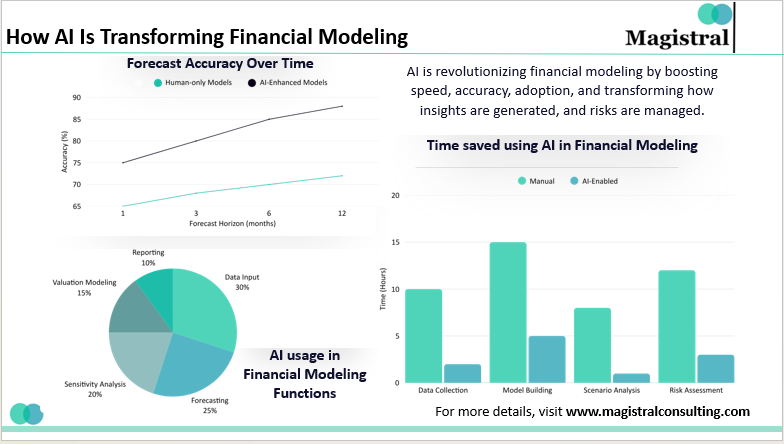
It is the use of artificial intelligence technologies in traditional financial modeling approaches such as discounted cash flow (DCF) models, leveraged buyouts (LBOs), and company comparable. AI processes bring automation, predictive analytics, and supervised learning into these processes, thus reducing human errors, improving forecast accuracy, and reducing time.

How AI is Revolutionizing Financial Modeling?

Automating Data Inputs

Financial modeling AI automates this process as analysts now tend to focus on higher value-added tasks. This artificial intelligence automatically ingests data as inputs, which would include market trends, economic indicators, and financial reports, thereby providing time-saving benefits to the user as well as eliminating errors caused due to manual entry.

Greater Accuracy of Predictions

Machine learning algorithms constitute the essence of financial modeling AI-analyzing historical financial data to better predict future trends. It is therefore for investors to improve their decision-making process using educated forecasts of revenues, expenses, and profits.

More Extensive Sensitivity Analysis

By automating traditionally manual sensitivity analyses, which quickly quantify the changes in assumptions on financial results, investors can better assess their decision making and investment opportunities with increased speed.

Quicker and More Efficient Financial Models

While building complex and in-depth financial models is very time-consuming, one can use AI to reduce this time significantly. For example, DCF building would normally involve multiple steps and data entries; however, an ordered AIS system can curtail this time many times over and thus expedite turnaround for investors who are analyzing multiple scenarios or in time-critical investment decisions.

How AI Is Transforming Financial Modeling

How AI Is Transforming Financial Modeling

Recent Trends in Financial Modeling AI

Big Data Integration

Next one is the trend where AI models make financial projections more accurately with big data. By way of ever-enlarging datasets coming from multitudes of sources, one offers projections which are more encompassing-they reflect a baser market condition.

AI to Safeguard ESG Investing

With ESG factors becoming well-trumped-their-chest jargon, its use within AI-based models is increasingly being embraced to spot ESG risks and opportunities within the financial models.

Cloud-Based Financial Modeling

Increasing numbers of financial institutions are migrating their financial modeling to cloud-based systems.

Financial modeling AI is used in determining the value of companies, assets, and investment opportunities. By incorporating machine learning, the AI system can adjust valuation models dynamically based on real-time data, improving investment accuracy.

Key Benefits of AI in Financial Modeling for Investors

Some of the key benefits of AI in Financial modeling are:

Speed Increase and Efficiency

From data gathering to scenario analysis, financial modeling AI speeds up each process in modeling. The quickening of the process has become more crucial because decisions need to be such that markets move quick by design.

Enhanced Accuracy and Consistency

The inconsistency borne out of human error in data entry and calculation is removed by AI. Hence, not merely quicker financial modeling is done but with greater accuracy, leading to more reliable insights.

Real-Time Data Competition

AI models can look at real-time data feeds and thus allow the finance professional to immediately react to changing market dynamics. This gives an edge to investors in terms of responding faster to changes in market conditions than the traditional way.

Risk Assessment at a higher level

AI-enabled financial models run countless simulations and market scenarios, helping investors better understand investment risks and make more informed decisions by analyzing large datasets.

Real-World Applications of AI in Financial Modeling

Investment Valuation

With financial modeling AI, companies, assets, and investment opportunities are assessed in terms of value. Using machine learning, valuation models can be made to change themselves based on real-time data, thus improving investment decisions.

Private Equity and Venture Capital

The financial modeling AI in the private equity and venture-capital fields assists analysts with the evaluation of potential investments, the running of market comparisons, and forecasting growth trends. This way deals are made faster, with portfolio management taking a more efficient approach.

Risk Management

An important function of AI is to analyze historical data and according to patterns recognize instances of possible risk. This should pave the way for harsher risk management and assure that investments pursue the risk tolerance of investors.

Challenges in Implementing AI in Financial Modeling

Some challenges can be outlined:

Data Quality and Availability

AI should have access to good-quality, clean data; otherwise, erroneous prediction and decision may occur due to false or missing data.

Integration with Legacy Systems

Many financial institutions still work with traditional means of financial modeling, and it is oftentimes a challenge to bring integration with AI even because of high costs.

Skill Gap

Organizations must train finance professionals in finance and AI to use AI-powered financial modeling tools effectively, requiring skill development or new talent acquisition.

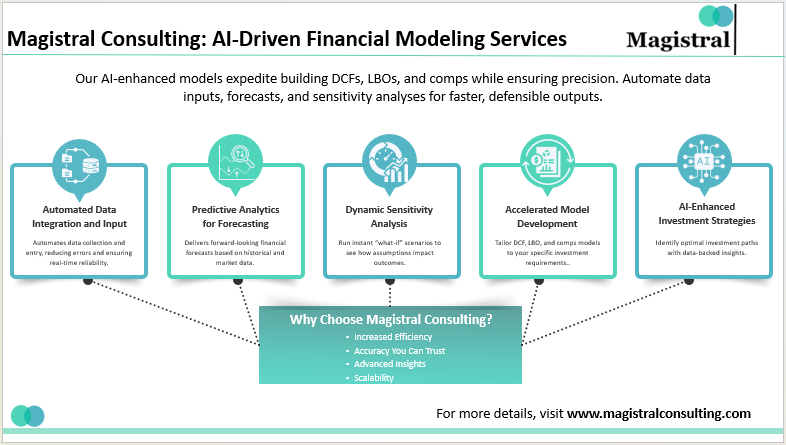
Magistral Consulting: AI-Driven Financial Modeling Services

At Magistral Consulting, we lead the way in combining advanced artificial intelligence with financial modeling. Our AI-based solutions simplify and optimize how businesses conduct financial analysis, delivering precise, timely, and actionable insights.

Magistral Consulting: AI-Driven Financial Modeling Services

Magistral Consulting: AI-Driven Financial Modeling Services

Our AI-Powered Financial Modeling Solutions Include:

Data Collection and Entry Automation

Our AI obtains and inputs financial data. This avoids human error and ensures reliable, up-to-date data goes into the models.

Predictive Analytics for Forecasting

We employ machine learning to build financial models for forecasting actual future performances.

Dynamic Sensitivity Analysis

The model allows you to check the effects of any changes in your assumption on financial outcomes easily so that you can explore these scenarios and decide wisely.

Accelerated Model Development

We customize our AI-enhanced DCF, LBO, or comps analysis services to fit your business requirements.

Investment decisions

Our AI solutions enable you to find which of the investment choices may even be better for you, based on a variety of factors.

Conclusion

As the financial landscape evolves, businesses increasingly demand precision, efficiency, and agility. The use of Artificial Intelligence for financial modeling is more of a disruption into the field that has changed all existing methodologies of financial analysis for those businesses and investors. In other words, AI-enabled financial models take away the drudgery of human inputs from data, allow better predictions, and shed lighting on hindsight, present, and forward-looking insights to facilitate faster and better decision-making.


About Magistral Consulting

Magistral Consulting has helped multiple funds and companies in outsourcing operations activities. It has service offerings for Private Equity, Venture Capital, Family Offices, Investment Banks, Asset Managers, Hedge Funds, Financial Consultants, Real Estate, REITs, RE funds, Corporates, and Portfolio companies. Its functional expertise is around Deal origination, Deal Execution, Due Diligence, Financial Modelling, Portfolio Management, and Equity Research

For setting up an appointment with a Magistral representative visit www.magistralconsulting.com/contact

About the Author

The article is authored by the Marketing Department of Magistral Consulting. For any business inquiries, you can reach out to prabhash.choudhary@magistralconsulting.com

AI improves financial decision-making by automating data inputs, performing predictive analytics, and running sensitivity analyses in real-time. This allows investors to quickly assess different scenarios, forecast outcomes more accurately, and adapt to market changes faster than traditional methods.

Key benefits include increased speed and efficiency, improved accuracy and consistency, real-time data processing, and advanced risk assessment. AI-driven models enable investors to make faster, more accurate decisions while managing risks more effectively.

Financial modeling AI is used in investment valuation, private equity, venture capital, and risk management. It helps investors assess potential investments, run market comparisons, and forecast growth trends, enabling more informed decision-making.

At Magistral Consulting, we offer AI-driven financial modeling services that automate data collection, enhance forecasting, run sensitivity analyses, and provide real-time insights. Our solutions are customized to meet the specific needs of businesses and investors, streamlining processes and accelerating decision-making.


Artificial intelligence is no longer something to be considered in the future for private equity firms; it is there now to stay, for good or for bad. By 2025, AI would transform everything into private equity-from the sourcing of deals to working with portfolio companies.

A Paradigm Shift: Surge in AI Adoption and Investment

The great AI boom has touched the private markets; it has done so with unprecedented force. Deriving its name from AI, AI in Private Equity reached $109.1 billion in 2024 in the US, thereby placing it far higher than any other contributor across the globe. Give some perspective: This amount was almost 12 times that of China’s $9.3 billion and nearly 24 times that of the U.K. at $4.5 billion. Private financing in generative AI alone reached $33.9 billion in 2024, rising by 18.7% from 2023, representing over 20% of all private AI investments worldwide.

AI Adoption and Investment

AI Adoption and Investment

This rush of capital speaks of growing belief that AI will bring change. This is an understandable state of affairs if we consider adoption numbers for enterprises: 78% of organizations would have integrated AI in some form by the end of 2024, up from just 55% a mere year before. Business use cases for generative AI surged in at least one way, almost doubling from 33% in 2023 to 71% in 2024.

For these changes, it makes it very compelling for PE firms to take AI forward as a firm strategic capability instead of just another tool for them.

Operational Efficiency and Strategic Gains: AI’s Impact Within PE Firms

Consulting firms have been visualizing for their clients how to orient their internal workings. In late 2024, 64% of firms then employed AI as part of their daily operations. Industry frontrunners like Blackstone have incorporated AI functionality in over 70 portfolio companies, enhancing various functions like dynamic pricing, staffing models, and operational performance tracking. AI is no longer just a productivity tool but a value driver itself. It is anticipated that by 2030, the U.S. private equity industry might prosper from the impact of AI by upwards of $406 billion, with increasing velocity and quality of decision-making seemingly taking precedence. Advanced machine learning models are now allowing these firms to wade through and interpret traditionally insurmountable volumes of both structured and unstructured data vis-vis conventional analytics.

The specific value proposition that consulting firms offer interfacing with their clients during this transition includes:

Designing AI transformation roadmaps

Integrating AI into core workflows like risk management and compliance.

Building scalable data architectures to support automation at scale.

Deal Sourcing and Due Diligence: Reinvented by AI

Historically, deal sourcing was dependent on personal networks, manual filtering, and long due diligence cycles. AI in Private Equity is changing this paradigm. AI-powered next-generation platforms are now able to sift through millions of public and private data points, pinpointing undervalued or high-growth targets with unprecedented accuracy and speed.

The payoff? Companies using AI for deal origination report finding 2–6 times as many deals while cutting down on time spent on low-potential opportunities. Natural language processing and predictive analytics allow these systems to search SEC filings, earnings calls, sentiment indicators, patent registries, and even social media discussions in real-time—something no human analyst could possibly do at scale.

Due diligence has also changed. AI in Private Equity now helps verify data from multiple sources, detect red flags in advance, and minimize human error. In high-stakes settings where the room for error is razor-thin, AI-powered due diligence substantially lowers acquisition risk.

Seven out of every ten PE CEOs consider AI in Private Equity adoption to be essential to remain competitive today, as significant change has occurred from voluntary innovation to strategic imperative.

Portfolio Management: AI for Value Creation and Predictive Control

Once an investment has been made, PE companies have the task of enhancing performance and achieving returns on their portfolio. Here too, there are new levels for value creation provided by AI.

Nearly 20% of portfolio companies operationalized use cases of generative AI as of late 2024, achieving real-world performance improvements, says Bain. The use cases cover demand forecasting, supply chain optimization, predicting customer churn, and marketing automation.

AI in Private Equity further drives real-time monitoring dashboards of portfolios that can surface anomalies, comparing performance, and providing predictive insights on a company or industry level. This allows PE managers to move from reactive to proactive intervention.

Consulting firms play an important role here. They assist in designing these monitoring systems, establishing early warning signs, and developing standard reporting frameworks that minimize delay time between the detection of issues and their solution.

During Q1 2024, AI in Private Equity startups saw between $52 billion and $73.1 billion in VC investment, accounting for 41–58% of worldwide VC investment. Private markets are providing exponentially more possibilities, with 24,500 AI in Private Equity companies versus only 727 public AI stocks—a ratio of investment of 33:1.

How Consulting Firms Can Drive AI Success in Private Equity

Though AI presents tremendous opportunity, realizing its value takes more than technology—it takes strategy, change management, and technical expertise. That’s where consulting firms are needed.

How Consulting Firms are Driving Al Success in PE

How Consulting Firms are Driving Al Success in PE

They support PE clients by:

Designing AI-Powered Platforms

From deal sourcing to diligence to monitoring, consultants can design end-to-end AI systems to fit a firm’s investment strategy and industry expertise.

Building Unified Data Ecosystems

Integration and quality of data tend to be the greatest impediments to successful AI. Consultants facilitate the development of scalable, secure, and compliant data models that drive analytics and automation.

Upskilling Talent

Most investment teams do not possess the technical skills in-house to implement AI in Private Equity. Consulting companies offer training programs, workshops, and playbooks to bridge the gap.

Driving Cultural and Organizational Change

Adoption of AI in Private Equity can encounter internal resistance. Consultants have an important role to play in leading changes. They also help in aligning leadership, and infusing AI into the DNA of the firm.

Services offered by magistral consulting for AI in Private Equity

Magistral Consulting provides a complete set of AI-powered services specifically designed for Private Equity (PE) companies. This helps in optimizing efficiency and decision-making in a range of investment processes. Their services combine sophisticated AI technologies with human intelligence to maximize deal sourcing, due diligence, portfolio management, and so on.

AI-Powered Deal Sourcing & Lead Generation

Magistral Consulting employs AI to screen big data sets and spot promising M&A and investment targets. Automation enhances deal flow quality and saves time on research.

AI-Enhanced Financial Modeling & Valuation

Our AI applications accelerate DCF, LBO, and comps modeling by automating data entry, forecasting, and sensitivity analysis—enhancing accuracy and speed.

AI-Driven Due Diligence & Risk Assessment

Magistral’s AI scans filings, reports, and market information to identify risks and produce due diligence insights in a timely manner, reducing time and expense.

AI-Enabled Market Research & Competitive Intelligence

AI applications track industries and competitors in real-time, delivering customized insights that inform wiser investment choices.

Automated Pitchbook & CIM Preparation

AI completes the process of creating pitchbooks, CIMs, and presentations, guaranteeing quick turnaround and consistency in investor materials.

AI in Private Equity -Augmented Equity & Credit Research

Magistral automates report generation on equity and credit, enabling analysts to cover more firms and emphasize in-depth insights.

AI-Backed Valuation Support

Our AI combines comparable and transactional data to provide real-time support with valuations, particularly effective in high-pressure deal situations.

AI-Powered Research Helpdesk

We provide ChatGPT-type AI bots for immediate access to internal data, reports, and models to enhance team productivity and decision-making.

AI-Driven Compliance Monitoring

Magistral’s AI keeps companies compliant by monitoring rule changes and automating surveillance, lowering legal and operational risk.


About Magistral Consulting

Magistral Consulting has helped multiple funds and companies in outsourcing operations activities. It has service offerings for Private Equity, Venture Capital, Family Offices, Investment Banks, Asset Managers, Hedge Funds, Financial Consultants, Real Estate, REITs, RE funds, Corporates, and Portfolio companies. Its functional expertise is around Deal origination, Deal Execution, Due Diligence, Financial Modelling, Portfolio Management, and Equity Research

For setting up an appointment with a Magistral representative visit www.magistralconsulting.com/contact

About the Author

The article is authored by the Marketing Department of Magistral Consulting. For any business inquiries, you can reach out to prabhash.choudhary@magistralconsulting.com

Consulting firms support PE clients through the creation of AI transformation strategies, the incorporation of AI in workflows such as compliance and risk management, developing scalable data systems, and overseeing change within portfolio companies.

AI-based platforms automate the examination of large data sets, uncovering high-potential targets more quickly and reliably. They also improve due diligence by confirming data, marking risks for early attention, and streamlining time-wasting low potential opportunities.

AI allows for real-time tracking, predictive analysis, and automation across industries such as supply chains, marketing, and forecasting. Almost 20% of portfolio firms put generative AI into practice in 2024, leading to quantifiable improvements in performance.

North America, particularly the U.S., leads in AI investment. PE firms are targeting sectors like healthcare, manufacturing, and finance, while also investing in infrastructure like clean energy and data centers to support AI scalability.