Tag Archives: Investment Research Outsourcing

The financial industry requires deep market intelligence to make hedging decisions and identify new investment possibilities. Banks, asset managers, hedge funds, and investment firms use sector research outsourcing in financial services as their primary operational approach to financial services delivery. As financial markets expand and data volumes grow exponentially, in-house teams often struggle to keep pace with sector-level analysis across industries such as technology, healthcare, real estate, and energy.

Institutions benefit from sector research outsourcing in financial services because it provides specialized analytical resources, advanced data tools, and affordable, skilled professionals. Financial institutions will increase their operational outsourcing expenses until 2025, according to Deloitte’s global financial services outlook, as they use outsourcing to delegate research to specialized partners while concentrating on core business functions.

Sector Research Outsourcing in Financial Services Market Growth and Importance

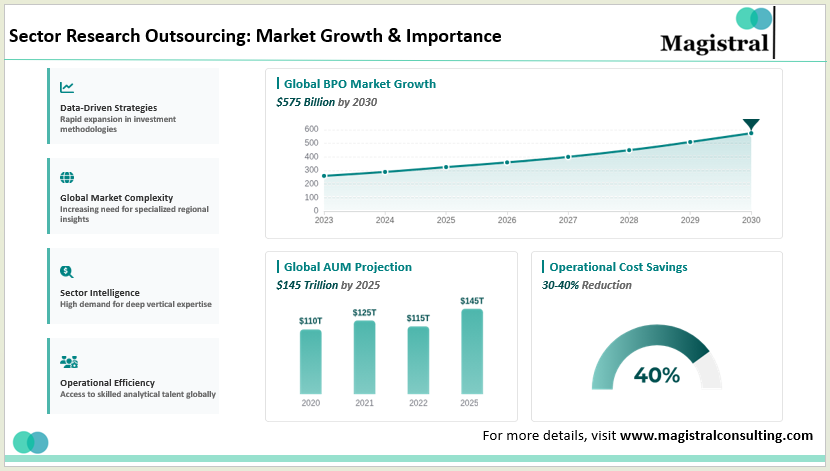
The financial services sector now depends on research outsourcing to empower its institutions with operational capabilities and industry expertise. The market demands that research organizations provide insights that help businesses track their investment risks and understand industry fluctuations. Precedence Research estimates that the worldwide business process outsourcing market will surpass $575.83 billion by 2030, with financial services driving most of this expansion.
Investment strategies that rely on data analysis require further development.
Sector Research Outsourcing: Market Growth & Importance

Sector Research Outsourcing: Market Growth & Importance

Expansion of Data-Driven Investment Strategies

Financial markets generate substantial data because they require sophisticated analytical tools and professional data analysis techniques. Institutional investors, therefore, combine sector analysis with valuation methods and outsourced research support to improve the accuracy of investment insights within Sector Research Outsourcing in Financial Services frameworks.

Growing Complexity of Global Financial Markets

The development of global financial markets creates interdependence between different markets, which leads to more complicated analysis procedures. The asset management industry needs dependable research about different market sectors because PwC projects global asset management will reach $145 trillion by 2025, increasing reliance on Sector Research Outsourcing in Financial Services.

Increasing Demand from Investment Firms

Investment firms require access to industry knowledge because they need to assess potential investment opportunities and associated risks. Private equity research partnerships enable organizations to develop their analytical capabilities while their internal teams concentrate on strategic investment activities, often supported by Sector Research Outsourcing in Financial Services providers.

Cost Efficiency and Talent Availability

Building large research teams that organizations can operate from their own facilities presents both high expenses and major difficulties for businesses. Financial institutions can achieve 30 to 40% research operational cost reductions through outsourcing, according to Deloitte.

Sector Research Outsourcing in Financial Services for Investment Decision Making

Financing research activities through outsourcing enables investors to assess industry trends and economic indicators, as well as specific business outcomes. Financial institutions use their dedicated analytical resources to discover investment possibilities that assist them in constructing their investment portfolios.

Industry Trend Analysis

Sector analysts study long-term industry developments through their research of technology innovation, renewable energy growth, and healthcare expansion. These insights help investors identify high-growth sectors and allocate capital more effectively.

Competitive Landscape Assessment

Companies require knowledge about their industry competitors to conduct proper business evaluations. Analysts investigate market share distribution together with pricing approaches and innovation skills, which research experts in venture capital commonly used to support their work.

Regulatory and Policy Monitoring

Regulatory changes create major effects that determine how industries will operate. Research teams that work externally monitor policy changes in different sectors to help investors modify their investment approaches.

Macroeconomic Impact Analysis

Economic indicators such as inflation, interest rates, and global trade conditions determine how different sectors will perform economically. The IMF predicts that worldwide economic development will reach a stable growth rate of approximately 3% per year, which will result in different business opportunities across various fields.

Technology and Analytics for Sector Research Outsourcing in Financial Services

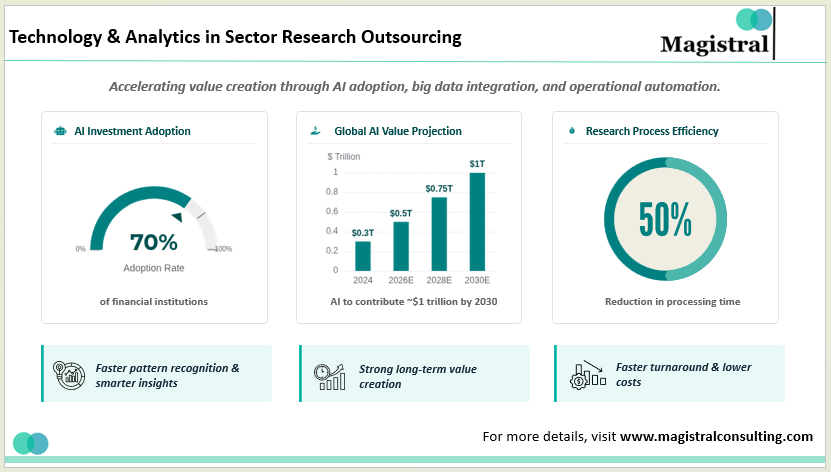
The sector research outsourcing operations of financial services companies are transforming technological advancements that enhance their analytical capabilities and generate better insights. Financial institutions increasingly integrate outsourced research activities with their digital systems, which include artificial intelligence and advanced data analytics, with PwC estimating that AI could contribute up to $1 trillion in value to financial services by 2030.
Technology & Analytics in Sector Research Outsourcing

Technology & Analytics in Sector Research Outsourcing

Adoption of Artificial Intelligence in Financial Research

Analysts use artificial intelligence to analyze large financial datasets, enabling them to identify investment patterns. More than 70% of financial institutions now allocate their resources toward developing artificial intelligence analytics systems, according to Deloitte, while McKinsey notes AI can reduce research processing time by up to 50 %.

Big Data and Alternative Data Sources

Research across industries now relies on alternative data sources, including transaction data, satellite imagery, and digital consumer behaviour patterns. The sources enable companies to gain deeper insights into their industry performance and emerging market trends.

Automation of Research Processes

Automation tools facilitate essential tasks, including gathering financial information and producing reports. Investment companies use outsourced research to enhance operational efficiency by integrating it with their fund-management data.

Integration with Portfolio Management Systems

Investment teams use outsourced research insights, integrating them with portfolio management systems to assess sector intelligence and evaluate financial metrics and market data.

Sector Research Outsourcing in Financial Services Risk Management and Strategy

The research outsourcing process in the financial services sector enables financial institutions to manage industry risks while developing their future business strategies. The Global Risk Survey conducted by PwC shows that more than 60% of financial institutions require industry risk assessment to support their long-term strategic planning.

Identifying Sector Specific Risks

All industries encounter unique obstacles, which include regulatory changes, technological advancements, and supply chain disturbances.

Scenario Modeling and Forecasting

Analysts use advanced financial models to create market condition simulations, which help them predict how different sectors will perform. The insights provide additional support for capital strategies that benefit from capital raising advisory services.

Enhancing Due Diligence Processes

Investors use in-depth sector studies to strengthen their investment due diligence processes through the assessment of market positioning, competitive strengths, and industry threats. The integrated due diligence frameworks used by investors combine third-party insights with operational due diligence approaches.

Sector Research Outsourcing in Financial Services and How Magistral Supports Investors

Institutions gain operational efficiency through specialized analytical abilities, which they obtain from sector research outsourcing in financial services. Magistral Consulting supports global investors by delivering detailed sector analysis, competitive intelligence, and financial research across multiple industries. The firm provides investment banks, asset managers, and private equity firms with data-driven insights through its scalable research teams, which enable them to make informed investment decisions in complex global markets.

About Magistral Consulting

Magistral Consulting has helped multiple funds and companies in outsourcing operations activities. It has service offerings for Private Equity, Venture Capital, Family Offices, Investment Banks, Asset Managers, Hedge Funds, Financial Consultants, Real Estate, REITs, RE funds, Corporates, and Portfolio companies. Its functional expertise is around Deal origination, Deal Execution, Due Diligence, Financial Modelling, Portfolio Management, and Equity Research

For setting up an appointment with a Magistral representative visit www.magistralconsulting.com/contact

About the Author

Nitin is a Partner and Co-Founder at Magistral Consulting. He is a Stanford Seed MBA (Marketing) and electronics engineer with 19 + years at S&P Global and Evalueserve, leading research, analytics, and inside‑sales teams. An investment‑ and financial‑research specialist, he has delivered due‑diligence, fund‑administration, and market‑entry projects for clients worldwide. He now shapes Magistral Consulting’s strategic direction, oversees global operations, and drives business‑development support.

FAQs

Why do financial institutions outsource sector research?

Financial institutions outsource sector research to access specialized expertise, reduce operational costs, and obtain faster insights into industry developments and market opportunities.

Which industries benefit most from sector research outsourcing?

Industries such as banking, asset management, private equity, venture capital, and hedge funds benefit significantly because their investment decisions depend heavily on industry level analysis.

How does technology improve sector research outsourcing?

Technology such as artificial intelligence, big data analytics, and automation tools enables research teams to process large datasets efficiently and generate deeper insights for investment decisions.

What role does sector research play in investment strategy?
Sector research helps investors evaluate industry trends, identify high-growth sectors, assess risks, and allocate capital effectively across different industries.

Outsourcing the preparation of Investment Committee (IC) memos is becoming increasingly popular among financial institutions, private equity firms, and venture capitalists. This practice ensures that decision-making processes are streamlined, efficient, and backed by comprehensive research. Outsourced IC Memo Preparation allows firms to focus on high-level strategic decisions while leaving the detailed, time-consuming tasks to external experts. This article explores the key benefits, processes, best practices, challenges, and future outlook for outsourcing IC memo preparation, ultimately helping organizations make informed, data-driven investment decisions.

Benefits of Outsourced IC Memo Preparation

Outsourced IC memo preparation provides several key advantages that can significantly enhance the efficiency and effectiveness of the decision-making process.

Benefits of Outsourced IC Memo Preparation

Benefits of Outsourced IC Memo Preparation

Cost Efficiency

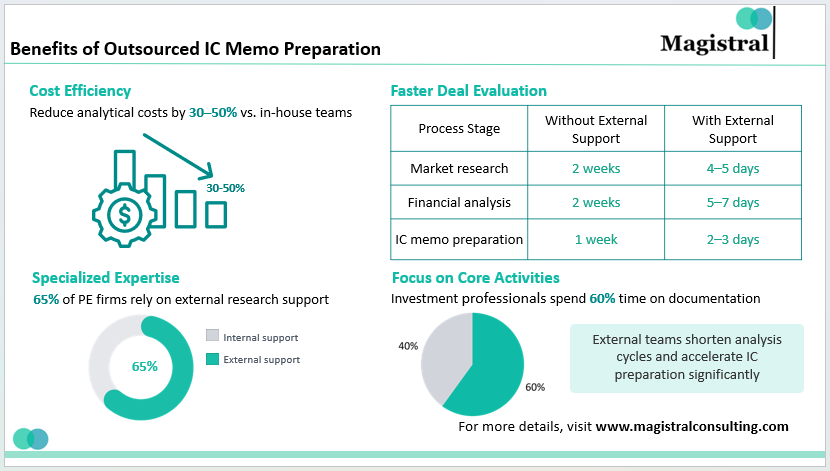
One of the primary reasons companies outsource IC memo preparation is the potential cost savings. Through Outsourced IC Memo Preparation, firms avoid the need to hire full-time employees or allocate internal resources to memo creation. This allows firms to focus their budgets on core business operations, which is especially crucial for startups and mid-sized firms that need to optimize operational costs.

Expertise and Specialization

Outsourcing to specialized firms or consultants ensures that the IC memo is prepared by experts who understand the intricacies of investment analysis, market trends, and financial modeling. These professionals bring in-depth knowledge, ensuring that the memo is of the highest quality and meets all necessary standards. The external team is equipped with the latest research tools, industry data, and market trends, enabling them to provide cutting-edge insights.

Improved Efficiency

Outsourced IC memo preparation allows for faster turnaround times. External firms have established workflows and processes that streamline the preparation of IC memos. This can be especially beneficial when dealing with tight deadlines or high-pressure investment decisions, as outsourced partners can often manage multiple projects simultaneously without compromising quality. Many investment firms now rely on outsourcing IC Memo Preparation to maintain consistent documentation standards across transactions.

Focus on Core Activities

By outsourcing the preparation of IC memos, in-house teams can focus on higher-level strategic tasks such as investment analysis, portfolio management, and client relationship building, rather than spending time on detailed documentation. This delegation not only saves time but also allows internal teams to concentrate on revenue-generating activities, such as deal sourcing and investor relations. In this way, Outsourced IC Memo Preparation becomes a productivity multiplier for investment teams.

The Process of Outsourced IC Memo Preparation

Understanding the steps involved in outsourced IC memo preparation can help firms ensure that the process is efficient and meets their expectations.

Initial Consultation and Briefing

The outsourcing partner typically begins by meeting with the firm’s leadership or investment team to understand the scope of the investment decision, the key issues to be addressed, and any specific data or requirements for the memo. This is a crucial step as it ensures the external team aligns with the firm’s goals and objectives, avoiding the need for major revisions later. A structured kick-off meeting helps ensure Outsourced IC Memo Preparation aligns closely with the firm’s investment framework.

Research and Data Collection

The external team conducts thorough research, including market analysis, industry reports, financial models, and due diligence findings. This data forms the backbone of the IC memo, providing the necessary insights to support investment decisions. This phase often involves gathering proprietary data, competitor analysis, and macroeconomic trends, which are critical for making informed investment decisions within the process.

Memo Drafting

Based on the research findings, the outsourcing partner drafts the memo, following a structured format. The memo includes key sections such as the investment thesis, risk analysis, financial projections, and strategic fit. It’s essential that the memo is clear, concise, and data driven. Additionally, the memo should consider any regulatory or compliance requirements relevant to the investment.

Review and Feedback

Once the draft is complete, the memo is reviewed by the client’s internal team, who provides feedback or requests revisions. This iterative process ensures that the memo aligns with the firm’s investment strategy and decision-making framework. Feedback should be specific to avoid ambiguity, particularly regarding financial metrics and risk evaluation.

Finalization and Delivery

After addressing any revisions or feedback, the final version of the IC memo is prepared and delivered to the investment committee. The memo is designed to be ready for presentation, helping the committee make informed decisions quickly. Some firms may opt for a brief executive summary for quick consumption, with detailed appendices for deeper dives.

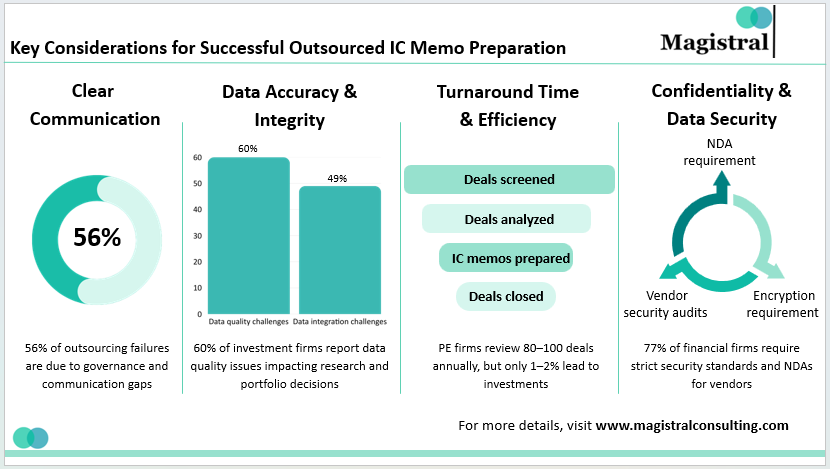
Key Considerations for Successful Outsourced IC Memo Preparation

When outsourcing IC memo preparation, there are several important considerations to ensure a successful partnership.

Key Considerations for Successful Outsourced IC Memo Preparation

Key Considerations for Successful Outsourced IC Memo Preparation

Clear Communication

It’s vital that there is a clear and open line of communication between the client firm and the outsourcing partner. Clear expectations and requirements should be established at the outset to avoid misunderstandings and ensure the memo aligns with the firm’s needs. This includes agreeing on data sources, formatting preferences, and key stakeholders in the review process.

Data Accuracy and Integrity

The accuracy of the data presented in the IC memo is critical. Firms should ensure that the outsourcing partner uses reliable, credible sources for market research and financial data. Any inconsistencies or inaccuracies could undermine the quality of the decision-making process. It’s essential that the external team cross-checks data, especially when drawing comparisons between similar investment opportunities.

Turnaround Time

The timeline for preparing the IC memo should be well-defined, with clear milestones and deadlines. Outsourcing partners should be capable of delivering high-quality work within the agreed timeframe to prevent delays in the decision-making process. Tight schedules can often be managed by outsourcing firms with robust project management systems in place.

Confidentiality and Security

Given the sensitive nature of investment decisions, firms must ensure that their outsourcing partner adheres to strict confidentiality and data security protocols. This protects both the firm’s strategic interests and any proprietary information. NDAs (Non-Disclosure Agreements) and data encryption should be a standard part of the contractual agreement with the outsourcing provider. Strong governance frameworks are particularly important in Outsourced IC Memo Preparation, where confidential deal information is frequently handled.

How Magistral Consulting Supports Outsourced IC Memo Preparation

Magistral Consulting offers comprehensive outsourced services for IC memo preparation, ensuring your investment decisions are backed by thorough analysis and professional insights.

Industry Expertise

With a deep understanding of various industries and investment landscapes, Magistral Consulting brings specialized knowledge to each memo, ensuring that all factors, including market trends and financial forecasts, are accurately represented through Outsourced IC Memo Preparation.

Data-Driven Approach

We leverage a range of credible sources, including reports from PwC, Deloitte, and other leading consultancies, to gather accurate and relevant data. This ensures that every memo we produce is not only well-written but also supported by the latest market research and industry insights.

Tailored Solutions

At Magistral Consulting, we understand that each investment decision is unique. Our team works closely with clients to customize each memo to meet their specific needs and objectives. Whether you are making a short-term investment or a long-term strategic decision, we ensure that the memo is tailored to your goals.

Timely Delivery

We pride ourselves on providing quick turnaround times without sacrificing quality. Our efficient processes and experienced team ensure that IC memos are delivered on time, every time.

End-to-End Support

From the initial briefing to final delivery, Magistral Consulting provides end-to-end support. We help clients make informed investment decisions with comprehensive, high-quality memos that meet all regulatory and strategic requirements through structured services.

About Magistral Consulting

Magistral Consulting has helped multiple funds and companies in outsourcing operations activities. It has service offerings for Private Equity, Venture Capital, Family Offices, Investment Banks, Asset Managers, Hedge Funds, Financial Consultants, Real Estate, REITs, RE funds, Corporates, and Portfolio companies. Its functional expertise is around Deal origination, Deal Execution, Due Diligence, Financial Modelling, Portfolio Management, and Equity Research

For setting up an appointment with a Magistral representative visit www.magistralconsulting.com/contact

About the Author

Tanya is an investment-research specialist with 6 + years advising venture-capital, private-equity and lending clients worldwide. A Stanford Seed alumnus with an MBA and an Economics (Hons) degree, she heads project teams at Magistral Consulting, delivering financial modelling, due-diligence and deal support on 3,000 + mandates. Her blend of rigorous analytics, sharp project management and clear client communication turns complex data into actionable investment insight.

FAQ’s

What is an IC memo?

An Investment Committee (IC) memo is a detailed document that outlines the key aspects of an investment opportunity, including the investment thesis, financial analysis, risk assessment, and strategic fit. It is presented to the investment committee to facilitate informed decision-making.

Why should firms outsource IC memo preparation?

Outsourcing IC memo preparation allows firms to save time and costs, gain access to expert analysis, and focus on higher-level strategic decisions. It also ensures the memo is data-driven and of the highest quality.

How long does it take to prepare an outsourced IC memo?

The preparation timeline depends on the complexity of the investment and the amount of research required. Typically, it can take anywhere from a few days to a couple of weeks for a comprehensive IC memo to be prepared and delivered.

What are the key components of an IC memo?

An IC memo typically includes an executive summary, investment thesis, market and industry analysis, financial projections, risk analysis, and a strategic fit assessment.

Global investment research plays a critical role in shaping financial strategies and decisions across the world’s capital markets. As global markets continue to grow and the economies of the world become more interconnected it has come to be that quite advanced and sophisticated global investment research techniques are needed by institutional investors, asset managers and hedge funds especially. Such investors rely on using developing techniques that involve macroeconomic analysis, sector knowledge as well as security-specific analysis in making investment decisions in very uncertain and dynamic markets.

Macroeconomic Dynamics and Geopolitical Influences

External environment and the risk factors can chiefly influence investment decisions.

COVID-19 Influence on Inflationary Trends

The COVID–19 outbreak significantly contributed to rising inflation all over the world and by the year 2020 inflation stood at 8.8% the highest in a couple of years. As a result of the inflationary pressures, the central banks resorted to very forceful monetary policies, with that of the US entering as high as 5.25%-5.50% rate in the year 2023.

For Emerging Markets

Rising inflation and the changes in policies led to a great deal of capital flight from emerging markets. This situation has resulted in depreciating currencies, recession, and low growth rates in the respective areas.

Disruption in Trade Activities

Lockdowns imposed on the outbreak of the pandemic disrupted trade activities greatly, revealing the extent of global business operations. Close to these trade wars are causes like the one between America and China which also affect investment decisions among other issues in sectors like technology, energy, and agriculture that face tariffs that threaten business.

Rationale of Continuous Tracking

The members of the global investment research teams should also ensure that they monitor current economic developments, as well as changes in the relevant policy environment towards the future. It is necessary to know how geo-political factors impact in order to devise investment plans that would succeed.

Sector-Specific Research Identifying Trends and Opportunities

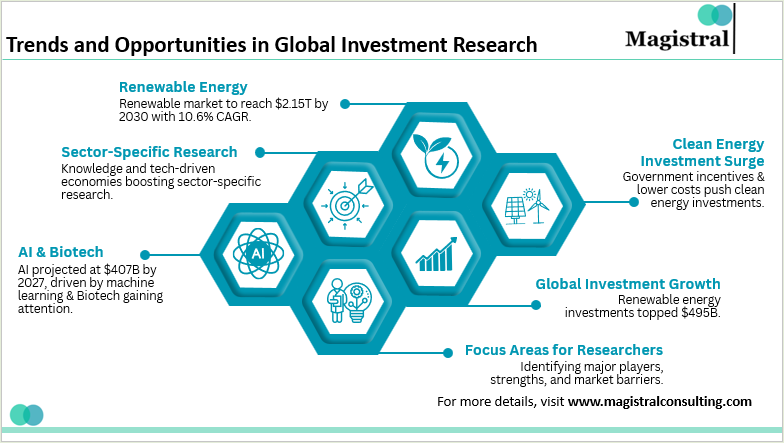
There are various trends in opportunities with regards to the different sectors. Some of them are:

Trends and Opportunities in Global Investment Research

Trends and Opportunities in Global Investment Research

Renewable Energy

In addition to the above, the renewable energy market is forecasted to grow in value to 2.15 trillion dollars by the year 2030 with the compound annual growth rate (CAGR) being 10.6%. This area has thus become a principal area of focus for a study on the trends of investments due to the changes towards the use of energy in a more sustainable manner.

Emerging Sectors AI & Biotech

Artificial Intelligence and Biotechnology are making their way towards convergence owing to the technology in these fields. The value of the AI industry can reach $407 billion by 2017, given the advances in machine learning and intelligence of various systems.

Investment In Clean Energy on The Rise

In reaction to these changes in perspectives, several nations have been providing crucial government returns on investment and the corresponding infrastructure costs for solar and wind, which has led to the clean energy drive seeing huge funding. In the year 2022 alone, the amount of money spent on clean energy projects out of all investments reached over 495 billion dollars, which indicates that investors have very positive expectations concerning this business.

Global Investment Growth

Increased investments in renewable energy, artificial intelligence, and biotechnology, among other levels, further affirm the global growth in investments. There has been a trend whereby technology and sustainability are driving most of the growth in such sectors.

Areas of Focus for Researchers

In the case of growing industries, global investment research teams are looking at the emerging industries, looking for the key players, their power and the barriers in the respective markets. This in turn puts most equities on an attractive investment climate for those who are concerned.

Quantitative Models and Advanced Data Analytics

Today quantitative analysis and applied big data science in global investment research are essential components of any investment research. In this respect, financial institutions have greatly utilized market models to assess future market performance. The global alternative data trends market in the financial services industry is expected to grow at a CAGR of 50.6% between 2024 and 2030. This is because of technological breakthroughs in machine learning and artificial intelligence.

Hedge funds have always been at the cutting edge as far as the development of sophisticated algorithms to engage in systematic trading optimally and more recently in high-frequency trading (HFT) which takes advantage of arbitrage opportunities. These funds apply sophisticated models to analyze huge amounts of data. This includes but not limited to historical prices of stocks, earnings data, and even social network sentiment. Studies on the subject have found that firms employing AI-based trading strategies outperform traditional strategies by about 25%.

The Role of Alternative Data in Decision-Making

Global investment research has experienced a shift with the incorporation of alternative data within its pyramid structure. Information obtained from various sources including satellite, web browsing, and geographical information gives current updates. This enables better decision-making for global investment research. The worldwide market for alternative data is predicted to expand at a CAGR of 52.1% between 2023 and 2030. This is because these insights assist investors in developing strategies.

For example, satellite images have enabled the modeling of dicot yield in regions. Thus, giving an alert when potential threats to food security arise. It can also extend to analyzing the social media sentiment towards the target brands or sectors to explain investor confidence.

The Future of Global Investment Research

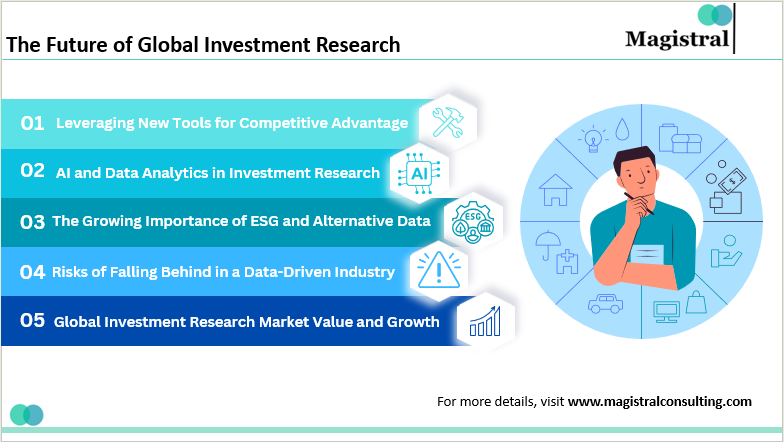
The future of global investment research is undergoing a significant transformation. This is driven by technological advancements and evolving market dynamics in every sector.

The Future of Global Investment Research

The Future of Global Investment Research

Technological Advancements Shaping Research

AI will transform capabilities in research, especially in the speed of making resultant decisions. Advanced Data Analytics tools will go beyond and widen the research undertaken enhancing the precision and insight obtained.

Introduction of ESG and Other Data

Environmental, Social and Governance (ESG) factors will increasingly influence the investment decision-making process. The use of alternative data will be part of the analysis process to enhance the existing traditional methods.

Market Development and Projection

The Market is forecasted to Reach In the year 2024. The size of the global investment research market is estimated to be worth $19.4 billion. Estimation of Future Business Performance Forecasted to have a Compound Annual Growth Rate (CAGR) of 6.2% in the proceeding five years.

Factors for the Successful Future of Investment Management Companies

Agencies which successfully employ sophisticated technologies with updated tools and methods, will be in a position to tackle the challenges of the world. In an information industry where information is time it is hard to survive for firms that remain in stagnation.

Magistral’s Services for Global Investment Research


Magistral Consulting provides a complete range of global investment research services intended to facilitate value-added investment decision-making throughout the investment process. Our research capabilities are ranked by sectors, markets, and geography so that those investment firms that count on us will always have the right insights for their investment strategies. Below you can find some of our services for global investment research

Industry Research

Magistral’s thorough Industry Research supports global investment research. We enable firms to gain deep insights into industry movements, market features, and competitive environments. We evaluate the drivers of growth, regulatory changes, new technologies, and general economies to deliver market-ready solutions. Be it finding the right market or going into the depths of the sector. Our industry research surfacing threats and opportunities for investments allows providing all with statistics-centered choices in foresight of practice.

Company Profiling and Competitive Landscaping

Our Company Profiling and Competitive Landscaping services include an in-depth understanding of a company and its place in a given industry. Magistral, for instance, assesses the financial status of target companies, their operational effectiveness, market presence, and strategic movements in comparison with other participants.

Preparing Investment Memos

For global investment research, we also assist in preparing investment memos. More specifically in composing Memos where relevant information is compiled, analyzed, and presented clearly and concisely. Such documents include industry analysis, company business and financial plans, investment risk levels, and other more relevant information. This gives investors an awareness of the opportunities in the investment.

Research Incoming Pipeline

Magistral also assists investment firms in enhancing their deal flow through the Research Incoming Pipeline. We examine and screen potential investment opportunities according to a set of criteria such as business financial strength, market share, growth capacity, risks, and others, by our professional team.


About Magistral Consulting

Magistral Consulting has helped multiple funds and companies in outsourcing operations activities. It has service offerings for Private Equity, Venture Capital, Family Offices, Investment Banks, Asset Managers, Hedge Funds, Financial Consultants, Real Estate, REITs, RE funds, Corporates, and Portfolio companies. Its functional expertise is around Deal origination, Deal Execution, Due Diligence, Financial Modelling, Portfolio Management, and Equity Research

For setting up an appointment with a Magistral representative visit www.magistralconsulting.com/contact

About the Author

The article is authored by the Marketing Department of Magistral Consulting. For any business inquiries, you can reach out to prabhash.choudhary@magistralconsulting.com

Alternative data refers to non-traditional data sources like satellite imagery, social media sentiment, and web analytics. This data provides real-time insights that traditional data may not capture, allowing investors to better assess consumer behavior, supply chain risks, and environmental factors, leading to more informed investment decisions.

Regulatory frameworks, such as MiFID II in the EU, have changed how investment research is consumed and paid for. Additionally, regulations in emerging markets like China and India are continually evolving, affecting capital flows, taxation, and corporate governance. Research teams must stay updated on regulatory changes to ensure compliance and mitigate risks.

The future of investment research lies in the growing integration of artificial intelligence, big data analytics, ESG considerations, and alternative data sources. Investment firms that adopt these technologies and approaches will be better positioned to manage the increasing complexities of global markets and stay competitive.

Introduction

Sensitivity Analysis is a financial modeling tool that examines how the values of a group of independent variables affect a single dependent variable under specified situations. Professionals apply sensitivity analysis—also known as a what-if study—across various domains, including biology, geography, economics, and engineering. In the corporate and economic sectors, financial analysts and economists frequently use it to assess different scenarios. It is particularly beneficial for studying and analyzing processes where the outcome is an opaque function of numerous inputs. An opaque function or process cannot be studied or analyzed. Climate models in geography, for example, are typically highly sophisticated. As a result, the precise relationship between the inputs and outputs is unknown.

Under a given set of assumptions, sensitivity analysis evaluates how various elements of an independent variable affect a specific dependent variable. In other words, sensitivity analyses look at how various sources of uncertainty in a mathematical model affect the total uncertainty of the model. This strategy is applied within certain boundaries dependent on one or more input variables.

Financial analysts most typically use a Financial Sensitivity Analysis, also known as a What-If analysis or a What-If simulation exercise, to forecast the outcome of a given action when executed under certain conditions. Financial Sensitivity Analysis is conducted within specific parameters set by independent variables.

Advantages of Sensitivity Analysis

The use of sensitivity analysis has several advantages. It is vital to remember that sensitivity analysis employs a set of outcomes based on assumptions and variables, which are then assessed against historical data. As a result, a sensitivity analysis is a model with some room for error that may or may not be completely accurate, but it is a practical and extensively used technique. The following are the main advantages of employing it:

Advantages of Sensitivity Analysis

Advantages of Sensitivity Analysis

Decision making

It gives decision-makers diverse options to choose from to make better business judgments. Sensitivity analysis aids in making well-informed decisions. Decision-makers use the model to decide how responsive the output is to changes in certain factors. As a result, the analyst can help in drawing factual findings and making the best judgments possible.

Predictions

It thoroughly examines factors, resulting in more accurate forecasts and models.

Areas for improvement

Sensitivity Analysis aids decision-makers in deciding where future improvements should be made. The analyst can be more flexible with the boundaries within which to assess the sensitivities of the dependent variables to the independent variables using Financial Sensitivity Analysis.

Credibility

Financial models gain credibility through sensitivity analysis, which assesses them across various scenarios.

Processes in Sensitivity Analysis

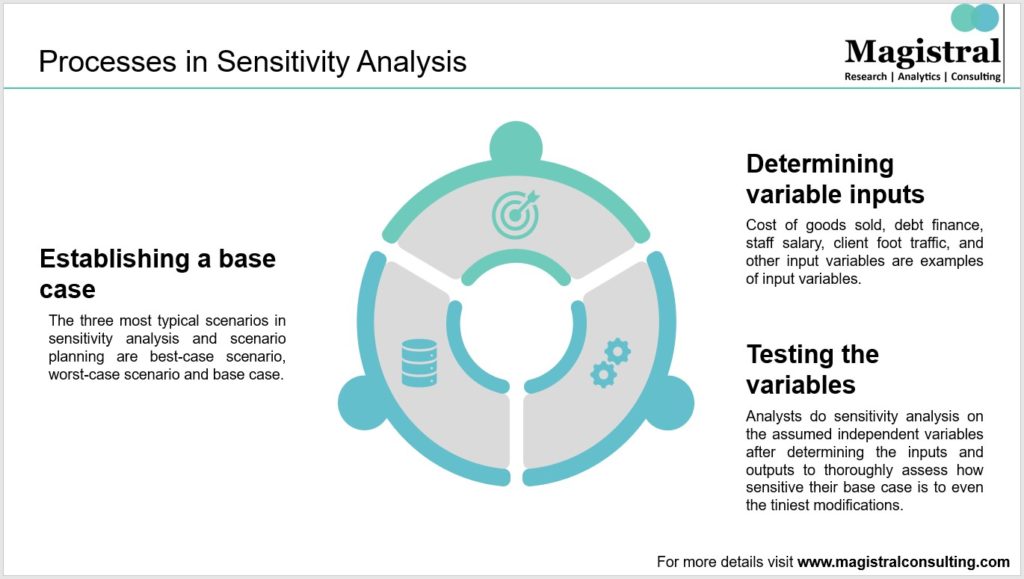
Sensitivity Analysis is a business model that shows how input factors change affect target variables. What-if or simulation analysis is other terms for this model. It is a method of predicting a decision’s outcome based on variables. An analyst can assess the impact of a change in one variable on the outcome by constructing a collection of variables. When performing a sensitivity analysis, analysts thoroughly examine both the input (independent) and goal (dependent) variables. They assess how changes in input variables influence the target outcome. Each sensitivity analysis typically involves three steps:

Processes in Sensitivity Analysis

Processes in Sensitivity Analysis

Establishing a base case

The three most typical scenarios in sensitivity analysis and scenario planning are:

-The best-case scenario, or the most optimistic scenario with the most upside potential

-The worst-case scenario or the most pessimistic situation with the most significant risk of failure.

-The base case, or the most cautious scenario, results in the middle of the best and worst-case possibilities.

Once they establish a plausible base case scenario, analysts will identify the most important independent and dependent factors influencing the outcome.

Determining variable inputs

Cost of goods sold, debt finance, staff salary, client foot traffic, and other input variables are examples of input variables. Cash flows, internal rate of return, net present value (NPV), and net profits are examples of output variables. For example, analysts often use net present value, which accounts for the time value of money, to estimate if a project will be lucrative.
Initial capital, the acceptable rate of return, and the return on investment from cash flows are all factors in NPV.

Testing the variables

Analysts do sensitivity analysis on the assumed independent variables after figuring out the inputs and outputs to thoroughly assess how sensitive their base case is to even the tiniest modifications.

Because it acts as a control, it is critical to use the base case as a frame of reference for the OAT analysis. Without a realistic base case scenario, there is no way to know how the best-case and worst-case possibilities will be affected. Multiple-input variables are more likely to change simultaneously or sequentially in the real world, often in dramatic and unpredictable ways.

Top Practices in Sensitivity Analysis

Layouts in Excel

For a successful sensitivity analysis in Excel, the layout, structure, and strategy are critical. If a model is poorly arranged, it confuses both the creator and the users and increases the chances of errors in the analysis.

The following are the most critical considerations for Excel layout include putting all the assumptions in one place in the model, formatting all assumptions in a different font color to make them stand out, considering which assumptions to test – only the most critical ones carefully and creating a separate section for the analysis using grouping.

Direct vs. Indirect methods

Different numbers are substituted into a model’s assumption in the direct method. Instead of directly altering the value of an assumption, the indirect method inserts a % change into calculations in the model.

Tables, charts, and graphs

Even the most informed and technically sophisticated finance experts may find it challenging to understand. Therefore, presenting the results in an easy-to-understand and follow format is critical.

Data tables are an excellent method to explain how changing up to two independent factors affects a dependent variable. The data table below illustrates changes in revenue growth and the EV/EBITDA multiple on a company’s stock price. Tornado charts are an excellent method to simultaneously display the impact of multiple variables. Analysts name them Tornado Charts because they arrange the items to resemble a tornado cone, placing the most impactful items at the top and the least impactful ones at the bottom.

Limitations in Performing Sensitivity Analysis

Analysts most commonly use Excel to create financial models. However, spreadsheets often fall short—they require extensive manual entry and offer little room for error. Conducting multidimensional analysis in a two-dimensional spreadsheet is also challenging. When stakeholders present new questions, analysts frequently return to the drawing board to build entirely new spreadsheets. These are significant to why intelligent firms should consider employing sensitivity analysis-specific financial modeling tools.

Magistral’s services on Sensitivity Analysis

Experts have long regarded financial models as a reliable method for identifying the contours of trade. Investors have recently tweaked traditional financial models qualitatively, driven by a wave of acquisitions where they pay significant premiums for explosive growth or high-impact technology. The sensitivity analysis provided by Magistral ensures the following:

-Analyzing the financial model’s unclear input values

-Predicting potential outcomes and planning for unanticipated risks

-Aiding the execution of risk assessment techniques

-Establishing co-relationships between the model’s multiple inputs and output.

-Execution of well-informed judgments

About Magistral consulting

Magistral Consulting has helped multiple funds and companies in outsourcing operations activities. It has service offerings for Private Equity, Venture Capital, Family OfficesInvestment BanksAsset Managers, Hedge Funds, Financial Consultants, Real Estate, REITs, RE fundsCorporates and Portfolio companies. Its functional expertise is in Deal originationDeal Execution, Due Diligence, Financial ModelingPortfolio Management and Equity Research.

For setting up an appointment with a Magistral representative visit www.magistralconsulting.com/contact

About the Author

The article is Authored by Marketing Department of Magistral Consulting. For any business inquiries, you could reach out to prabhash.choudhary@magistralconsulting.com

Introduction

Investment Banking is a special type of banking that helps organizations or individuals raise capital and provides consulting services to them. It helps in conducting large complicated transactions such as mergers or acquisitions or raising an initial public offering (IPO) using underwriting.

Investment Bankers are experts in the field of finance who have their fingers on the pulse of the market. As acknowledged worldwide this is one of the most complex financial mechanisms in the world.

As has been the case with different sectors, it has been for some time now that organizations have started investment banking outsourcing services to third-party vendors as well. Outsourcing one means giving the authority to outsource one of its services to these third-party vendors so that the company can save on operating costs and get specialized services from highly skilled staff- all this while ensuring adequate data security and adherence to regulatory compliances.

This helps organizations not only streamline their services but also provide value-added services to customers that they couldn’t have thought about earlier.

It is important to note that the nature of investment banking outsourcing and the services provided by vendors have evolved alongside technological advancements. The first and foremost is business digitization, which has resulted in increased transparency and visibility for clients, as well as a better end-user experience for customers. This has resulted in improved strategic partnerships and, as a result, higher quality work being outsourced by investment banking outsourcing clients, which can only be met with strategic partners.

Challenges Faced by Investment Banks

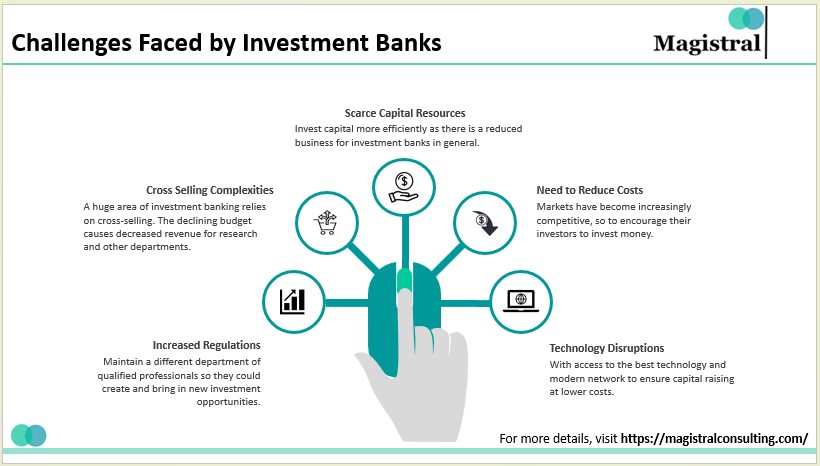
Modern investment banking faces various kinds of challenges that are listed below:

Challenges Faced By Investment Banks

Challenges Faced By Investment Banks

Scarce Capital Resources

Due to recession and depression all over the world, almost all markets, companies, and individuals are not comfortable investing their money in the capital markets. This has created a world where capital resources have become scarce. The job of an investment banker is to invest capital more efficiently. But due to the scarcity of resources, there is a reduced business for investment banks in general.

Need to Reduce Costs

Markets have become more competitive. As a result, the cost of goods and services is decreasing. This has an impact on the finance industry as well. Investment banks’ margins are shrinking, and thus their cost of capital is decreasing. As a result, they must reduce costs to encourage their investors to invest money.

Increased Regulations

The new structured products created and sold by investment banks go through strict regulations since the mortgage crisis in 2008. This creates a limit on the operations of investment banks. These increases cost for investment banks and they have to maintain a different department of qualified professionals. So that they could create and bring in new investment opportunities after scrutinizing them.

Technology Disruptions

Rapid technological advancements have drastically altered every industry in the world, including investment banking. The fintech industry has emerged over the years as new technology. This industry revolves around providing the same financial services at a lower cost. They have access to cutting-edge technology and a modern network, allowing them to raise capital at a lower cost.

Cross Selling Complexities

A huge area of the investment banking services sector relies on cross-selling. For example, if someone is looking for mergers and acquisitions, the investment bankers provide them with the services such as issue management, capital structure advisory, and many more. This way they bring value to their clients. But due to limited budgets, they are limited to the services they offer. The declining budget causes decreased revenue for research and other departments.

Benefits of Investment Banking Outsourcing

There are several reasons why investment banking outsourcing is becoming increasingly popular. We have tried to highlight some of these reasons below. They are:

Benefits of Investment Banking

Benefits of Investment Banking

Focus on Core Business

Investment banking outsourcing can help companies in focusing on their core competencies rather than focusing on mundane tasks and being worried about their day-to-day operations.

Controlled Costs

Cutting operational costs is a challenge that exists with organizations throughout. Investment banking outsourcing provides an avenue where companies can take care of differences in the relative value of currencies to derive as much as 30-50% savings in costs.

Increased Efficiency

Investment banking outsourcing is a specialized operation and the workers who work for these banks need to be highly skilled for this. A similar talent of MBA’s exists in low-cost destinations like India where the operations can be outsourced to them. Highly skilled talent helps in improving the efficiency of investment banking services.

Changing Economic Factors

In today’s uncertain world, the political dynamics are changing daily. This has an impact on the economies of the world. Since we are so intertwined today the ripple effects of adverse conditions in a globally connected country are bound to have effects on the whole world. Investment banking outsourcing ensures the risks are well hedged with specialized partners operating from different geographies across the world.

Technological Changes

Investment banking outsourcing has ensured that the companies are up to date with the latest technological advancements that are occurring worldwide at a fraction of the cost had they invested real-time into adopting them. The use of the latest technologies by third parties ensures that all the technological challenges are met.

Time Zone Advantage

The gap in time zones between your country and the area you are outsourcing to, in addition to the cost advantage, is another important benefit. By doing so, you can focus on your primary tasks all day long while also having finished your day-to-day operations by the time you get up the next day. It gives you the benefit of round-the-clock business operations.

Magistral’s Services on Investment Banking Outsourcing

The outsourcing of investment banking may be a way to cut operating expenses. In an era of growing complexity in both established and new industries, investment banks are extremely nuanced. Smaller investment banks have a difficult time juggling their project pipelines and manpower needs. Medium-sized banks are eager to develop their expertise in emerging industries, which are bustling with activity and volume. However, large banks are more concerned with cutting costs while maintaining the quality of the services they provide to their customers. Magistral provides a range of service options to support Investment Banks.

Some of the services that are associated with Investment Banking Outsourcing that is offered by Magistral consulting are:

-Deal Sourcing: Performing industry and market analysis, finding potential targets, and publishing newsletters are various kinds of services provided under deal sourcing.

-Data Cleansing: Teams clean and mine data to ensure only accurate and relevant data is used for analysis.

-Valuations: Analysts create financial models using methods such as LBO, DCF, Comparable Analysis, Precedent Transaction Analysis, and Impact Analysis to perform precise valuations.

-Due Diligence: Researchers conduct both primary and secondary due diligence to uncover an asset’s true potential and provide an independent opinion on its investment quality.

-Deal Execution: Teams prepare teasers and investment memorandums while identifying and engaging potential investors or buyers.

-Portfolio Management: Providing ESG compliance monitoring, preparing financial reports, business development support, and procurement support is provided.

-Equity Research and Analysis: The services provided under this head include fundamental analysis, quantitative analysis, credit analysis, and country analysis.

-Marketing: This includes creating white papers, case studies, thought papers, CRM management, etc.

About Magistral Consulting

Magistral Consulting has helped multiple funds and companies in outsourcing operations activities. It has service offerings for Private Equity, Venture Capital, Family OfficesInvestment BanksAsset Managers, Hedge Funds, Financial Consultants, Real Estate, REITs, RE fundsCorporates, and Portfolio companies. Its functional expertise is around Deal originationDeal Execution, Due Diligence, Financial ModellingPortfolio Management, and Equity Research.

For setting up an appointment with a Magistral representative visit www.magistralconsulting.com/contact

About the Author

The article is Authored by the Marketing Department of Magistral Consulting. For any business inquiries, you could reach out to  prabhash.choudhary@magistralconsulting.com

Introduction

Around the globe, there is a trillion-dollar business of investing in all sorts of assets like equity, both public and private, real estate, and upcoming assets like cryptocurrencies. Once the investment is made, the task on the part of the investor shifts to investment management. There are many activities of investment management that could be outsourced and that is what leads us to analyze the stream of investment management outsourcing. Investment management and hence investment management outsourcing takes all forms depending on the asset being invested in, and the prime business of the asset or investment manager.

Here we take a look at major activities of each type of investment manager or asset manager which could be effectively outsourced to save on costs and improve quality.

Who Should Outsource Investment Management and How?

Outsourced Investment Management

Outsourced Investment Management for different types of Asset Managers

Private Equity and Venture Capital firms

The underlying asset that a Private Equity or a Venture Capital firm invests in is equity. Sometimes it’s for stocks listed on exchanges but most of the time these are private investments, the target of which are start-ups are unlisted companies.

In the PE/VC value chain of investing, there are activities like Fundraising, Deal origination, Deal execution, and Portfolio Management. Quite a few activities in these departments are outsourceable. For fundraising, the activities like investor reach-out, investor profiling, CRMs, newsletters, white papers, and data management jobs could be effectively outsourced. Regarding, Deal origination, the deal pipeline management has a great potential of outsourcing along with initial due diligence. Deal execution processes like valuation and financial modeling are templatized and could be considered. Portfolio management has varied activities and outsourcing potential vary as per the nature of the business of the portfolio companies. Most activities related to Strategy and Marketing have great potential for outsourcing when it comes to Portfolio Management.

Hedge Funds

For the most common type of hedge fund out there, that is a long-short equity hedge fund, multiple activities should be considered for outsourcing. Equity Research is the foremost one. The research that is done for the investors is almost always best to be outsourced. Apart from Equity Research, Fund Administration and Fund Accounting are better done when outsourced. It makes sense from the cost and expertise point of view. Marketing activities almost always have great potential for offshoring.

Real Estate

Managing a real estate asset after the investment comprises standardized work-streams. Most of it relates to collecting data, analyzing it, making reports, and raising red flags if any. Accounting and administration along with research has a great potential for outsourcing

Investment Banks

Investment Banks are into all sorts of assets directly or for their clients. For the varying types of their work pallet, there is varying potential for outsourcing.  For investment banks, activities that are commonly outsourced are Equity Research, Security-based Investment Research, development of excel or other automated models, investment research for private investments, marketing, deal origination, and deal execution. In fact, 30-50% of all activities performed by an investment bank has a solid potential for outsourcing that may be explored

Asset Management Firms

These are for specialized asset managers like managers managing a portfolio of crypto or commodities. There is no one size fits all approach to outsourcing for these asset managers. As a thumb rule, everything related to technology like platform development, automation, website development, or software development can be outsourced. Also, anything that is of support function’s nature like Strategy or Marketing could be looked at.

Models of engagement with the outsourcing vendor

Once you have made your mind to explore outsourcing, the biggest concern is around the way an outsourced vendor or the service provider would work with you and your team. There are three established models of working while outsourcing. These are FTEs, Retainer, and Ad-hoc. Some progressive vendors like Magistral are signing up success-based contracts too.

Outsourcing Engagement Model

Investment Management Outsourcing Engagement Model

FTEs

FTE the most common engagement model for investment management outsourcing.

FTE stands for Full-Time Employee equivalent. It’s like a virtual employee who is operating from a different country. This virtual employee could be coordinated with, on email, video calls, WhatsApp, chats, or any other mode that is suitable to the client and is convenient as per time zone differences. It looks like a person is aligned with the client full time and he works seamlessly with the client. That is always the case, but the vendor, his processes, training, supervision, and culture play a big role in ensuring the continuity of services. A vendor enables the FTE to perform optimally by providing training and desired supervision. The vendor’s processes ensure that the client is insulated from the bad performance of FTE as the work is supervised by more senior resources. In case the individual decides to leave the organization, similarly, qualified and trained professionals are available on the bench for the replacement. That is the reason it makes sense to work with individuals through the service providers who may be an established name in their industry. Working directly through freelancing websites or hiring directly exposes clients to manage costs and risks, which is not the case while dealing with an established service provider.

This also is the cheapest model on per hour basis. But it is inflexible as there may be contractual obligations for a minimum period of support. This case is more prominent when resources are specialized in niche skills

Typical jobs that require FTE engagements are operational, where the offshored team works with the onsite team seamlessly. So, if a task is part of your ongoing investment management operations, mostly it will be outsourced on FTE-based engagement.

Retainer

You know there is a need for outsourcing tasks. At the same time, you think a full-time individual working on these jobs may be overkill. In these situations, where tasks just require some hours every month, the retainer model of engagement comes in handy. Say rather than hiring an FTE or a full-time virtual employee, you would only want 100 hours’ worth of tasks outsourced every month. A retainer is far more flexible than FTEs but costs higher on per hour cost basis. Typical jobs that are suitable for retainer-type outsourcing are newsletters, MIS, reports preparation, and other marketing-related tasks.

Ad-hoc Projects

As the name suggests the engagement is for one-time projects only. A client gives out the scope of the project. The service provider or the vendor provides a proposal that carries, scope of work, timelines, and commercials. The project kicks off after the client signs off the proposal and is paid after the delivery of the project. Almost any project that is strategic and is not expected to be repeated on an ongoing basis is an ideal candidate for ad-hoc based outsourcing. Also, it’s an ideal mode, if you would want to test the services of a vendor before signing a longer-term contract. It is the most flexible outsourcing arrangement as projects may start or end at your convenience, but at the same time, it is costliest in terms of cost per hour basis.

Success Based

Most traditional service providers shy from signing a success-based engagement. The fear stems from the trust deficit, performance fears, and the complications of defining a success scenario. Magistral signs success-based engagements with clients, with whom it has existing relationships. Existing relationships take the risks related to trust deficit and performance. A mutually agreed “success” scenario could also be defined in those situations. The tasks that are outsourced under these arrangements usually relate to fundraising, deal sourcing, and meetings’ set up

Magistral has helped more than 100 clients in outsourcing and offshoring multiple activities related to the Investment Management process. To start a conversation drop a line here.

About Magistral

Magistral Consulting has helped multiple funds and companies in outsourcing operations activities. It has service offerings for Private Equity, Venture Capital, Family OfficesInvestment BanksAsset Managers, Hedge Funds, Financial Consultants, Real Estate, REITs, RE fundsCorporates and Portfolio companies. Its functional expertise is around Deal originationDeal Execution, Due Diligence, Financial ModelingPortfolio Management and Equity Research

For setting up an appointment with a Magistral representative visit www.magistralconsulting.com/contact

About the Author

The Author, Prabhash Choudhary is the CEO of Magistral Consulting and can be reached at Prabhash.choudhary@magistralconsutling.com for any queries or business inquiries.


Investment Research Outsourcing

Multiple Investment Services firms like Investment Banks, Private Equity, Venture Capital, Hedge Funds, Family Offices, and Asset Management firms are looking to outsource investment research in the post-Covid 19 pandemic era. The article describes the concept of Investment Research and the ways to go about outsourcing the process.

What is Investment Research? Investment Research Definition

Investment Research and Analysis or Investment Analytics combines multiple activities related to investments in Equity of companies (both public and private) and other financial instruments.

The major activities related to securities research are equity research, Fixed Income and Credit Research, Index and Quantitative Research, and Macroeconomic Research.

Another important aspect of Investment research is the support services towards Corporate Finance and Valuations. It includes activities like Investment banking support, Valuation support, business information services, and Private Equity and Venture Capital support.

Investment research also comprise of data governance-related activities like outsourced CFO.

Is Outsourcing a Good Idea?

Investment Research Outsourcing is fast catching up. Here are the trends that are leading to expending the concept of Investment Research Outsourcing

The pressure to lower costs: Investment Banking is not what it used to be. The digital world has shrunk the opportunities to make big dollars brokering big deals or IPOs. This has also led to pressure on costs. This leads to outsourcing non-critical jobs to low-cost countries like India.

Diversification on investment types: An Investment manager has way too many asset classes to handle today. It’s not only limited to public equity but now has diversified into private equity, real estate, cryptocurrencies, commodities, REITs, Index-linked instruments, and many other asset classes. If the investment team is small, it’s difficult to have a combination of skillsets to provide a holistic solution to their clients. As outsourcing vendors understand Investment Research dynamics well, Outsourcing helps in bridging the skill gap. Outsourcing vendors also have access to multiple investment research tools.

Information Sources and Databases: With the proliferation in investment type, also gone up is the requirement of multiple databases for varied data points. It’s a costly affair to maintain access to multiple databases in-house. Investment research tools are also used to fine-tune the data and information.

Confidentiality: There is pressure to keep all information confidential. An outsourced team doing due diligence is perfect, as it leaves no trace of who the client maybe, that is doing the due diligence. An analyst can talk to potential target with or without introducing the client.

Quality: Outsourced players have better quality than the in-house team. The outsourced team typically is bigger and has done similar tasks multiple times before. In the process, they usually create an information bank or templates that are ready to use. They also sit on the hoard of best practices for multiple situations. If the outsourced player has its knowledge process well documented, they are in a better position to offer work quality.

Effective Supervision: When internal teams are working on an analytical project, it’s difficult for a partner to take time out to get into the details of data, information, and analytics therein. But with an experienced outsourcing player, there are multiple levels of supervision, governance structures, and quality control processes to establish an error-free work every time.

Variable Costs: Firms can modify the outsourcing agreement to pay based on hours consumed or per assignment outsourced, rather than hiring a full-time virtual investment analysis. This brings immense flexibility in terms of costs. An investment firm can hire only for the assignment and then go back to the original structure, once the job is done. This is very useful for smaller investment teams and firms with partners only, who need an on-demand investment research analyst. An investment research team can come together ad-hoc and then could be dismantled when the job is done.

What jobs can be performed with Outsourced Investment Research?
Outsourced Investment Research Activities

There are multiple elements of the Investment Research Process, that could be potentially outsourced:

Equity Research: Equity Research is the most voluminous work as Investment Banks usually outsource quantitative investment research. Equity research teams typically conduct fundamental analysis on a set of regularly tracked stocks. They publish a report each quarter for every stock covered, detailing developments and valuation-related metrics. These Investment Research Reports are updated periodically, and their format is customized based on client preferences. Outsourcing this activity allows the in-house team to cover more stocks than it would have covered otherwise. Teams can also break this task into multiple streams before outsourcing—for example, preparing the DCF model, updating it periodically, or analyzing investor calls from the company’s management. Investment Research Analysts work as an extended offshore team to the in-house team. Investment research software aids the in-house tech capability.

Due Diligence of Private and Public Companies: Due diligence is time-consuming and requires huge efforts. Sometimes the due diligence can last even for a year analyzing tons of data and information. A dedicated support team that handles requests and delivers as promised enhances efficiency and ensures due diligence is completed within prescribed timelines and at appropriate valuations. It also ensures that the asset delivers the intended value for investors post-investment.

Fund Administration and Investor Relations: There are multiple activities of fund administration and investor relations that could be outsourced like Newsletters, MISs, Expense Tracking, Accounting, Company Registration, and multiple other similar activities. Firms use Investment Research Management Software or Investment Research Platforms to coordinate and streamline multiple related activities.

Outsourced CFO/ Outsourced CMO/ Outsourced CPO for portfolio companies: This is very relevant for Venture Capital and Private Equity firms that go into the nitty-gritty of operations for portfolio companies. Rather than hiring a full-time Chief Financial Officer, Chief Marketing Officer, or Chief Procurement Officer, one can just outsource these activities and pay for the services when needed. Some activities related to lead generation in sales and business development could be outsourced as well. Outsourced CFO is the most popular option.

Research and Strategy: Organizations generally run Research and Strategy projects parallel to core operations. These projects often experience phases of hyperactivity followed by periods of lull in the number of initiatives undertaken. Outsourcing these keep the focus of operations’ team on the day to day operations and an unbiased view of the strategic potential from someone who has a fresh eyes perspective on things.

Financial Modeling: Financial modeling is more of an art than science. Asking the right questions and capturing detailed insights is a skill developed over time. Most internal teams lack expertise in these tasks, as they typically handle them only occasionally. An outsourcing entity has ready templates and has done these over time to know the exact pain points and the right questions for the perfect financial model. Investment Banking Research Analysts are well versed with multiple aspects of financial modeling.

Deal Origination: Private Equity and Venture Capital firms must continually populate their deal pipeline to operate like well-oiled machines. They can effectively outsource most deal origination activities by breaking them into sub-activities and delegating non-critical tasks. While the firm retains investment decision-making in-house, it can outsource company profiling, list generation, and initial due diligence. After making an investment decision, the firm can also outsource parts of the detailed due diligence process.

How to Go About Outsourcing Investment Research?

There are multiple investment research companies and investment research firms which assist in outsourcing investment research services by offering virtual investment research analyst. They are varied in size and geographical presence. There are multiple investment research firms in India, that offer low-cost advantages.  You can make a list of suitable vendors either from Google search, references or when a sales leader reaches out to you. The very first step towards establishing suitability is to ask for past work samples. Once you have had a look at the work samples and they appear good quality, ask for a proposal for a pilot project. Teams undertake a pilot as a smaller project before outsourcing a larger portion of the operations, allowing them to assess capabilities and ensure alignment.

A pilot project should ideally last from a week to a quarter. This should give you ample time to experience the vendor’s capability and skills. Once the pilot succeeds, you should negotiate a larger engagement. Also, ensure the vendor offers competitive pricing for the quality of services delivered.

Magistral Consulting has helped dozens of buy-sides and sell-side firms in outsourcing their investment research operations. It is one of the leading Investment Research companies in India with the capability of performing global investment research. A one-stop-shop for all requirements of investment research and analysis. It has delivery centers in India that give it a cost advantage with sales offices in all the major cities across the world. To drop a business inquiry with Magistral, click, https://magistralconsulting.com/contact/

The author, Prabhash Choudhary is the CEO of Magistral Consulting and can be reached at Prabhash.choudhary@magistralconsulting.com for any queries. For further details on Magistral and its services, visit www.magistralconsulting.com